

The Rest is Propaganda
Alastair Campbell and Rory Stewart blow a Fuse promoting solar power
Introduction
I have a confession to make. Sometimes I listen to the Rest is Politics with Alastair Campbell and Rory Stewart. Not out of choice you understand, but because for some inexplicable reason, my wife likes Rory Stewart and sometimes I am in the same room, so I am compelled to listen if only for a short while.
The YouTube channel for The Rest is Politics claims Rory and Alastair have joined forces from across the political divide to lift the lid on the secrets of Westminster while bringing back the art of disagreeing agreeably. The podcast is “powered by Fuse Energy”.
Alastair Campbell is perhaps best known for elevating the art of spin to new heights as Blair’s official spokesman. In a sane world facts would be analysed, policy would be decided based on those facts and a narrative would be constructed to describe the facts and explain the logical steps that led to the policy. Under Campbell, the narrative was everything and became detached from the underlying facts. In other words the Number 10 Press Office became a propaganda machine that “lost all credibility as a reliable, truthful, objective operation”. Anyone remember the dodgy dossier that claimed non-existent weapons of mass destruction could be deployed within 45 minutes as the narrative for supporting war in Iraq?
Rory Stewart is the former Tory MP and minister who said he would probably vote Lib Dem or Green at the last election. He suffers badly from both Trump and Boris Derangement Syndrome, getting the US election result spectacularly wrong and was unable to come to terms with Brexit. He does not really reach across the political divide: he is simply a leftist with a posh accent or a Conservative In Name Only.
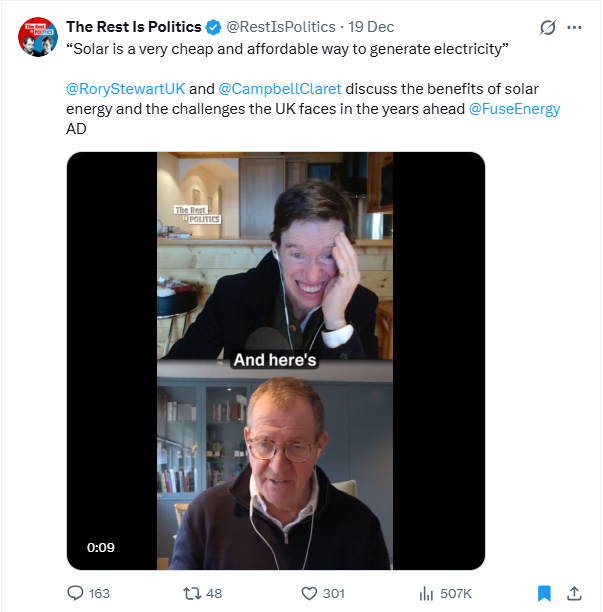
Sometimes I come across short videos of their output on X and can just about stomach those for 90 seconds or so. The inspiration for this week’s article was the recent clip (see Figure 1), sponsored by Fuse Energy where they sang the praises of solar power and the art of spin was again very much in evidence.
Rory and Alastair’s Claims
Rory celebrated solar power currently taking up 0.1% of UK landmass and stated it was driving up fast and we could reach 1% of the landmass covered in solar. He then claimed solar is a “very cheap and affordable way to generate electricity”. He did note that there were problems in siting solar farms close to the grid and close to the source of demand and many people find them to be big industrial intrusions on our landscape.
Alastair then asked if he was weird, because he loves looking at huge solar farms and Trump’s windmills. He then went on to promote Fuse Energy, saying they are “on the case” and “Britain’s clean energy future will appear field by field”. Apparently, solar will fit naturally into the landscape, strengthen communities and bring long term value to the land. He then went on to promote Fuse Energy’s land acquisition arm, suggesting viewers could win £2,000 by referring a new site to them.
The Real Cost of Solar
Unfortunately, this video is as dodgy as the dossier from 20-odd years ago. As we have covered before, solar power is among the most expensive on the grid today, see Figure 2.
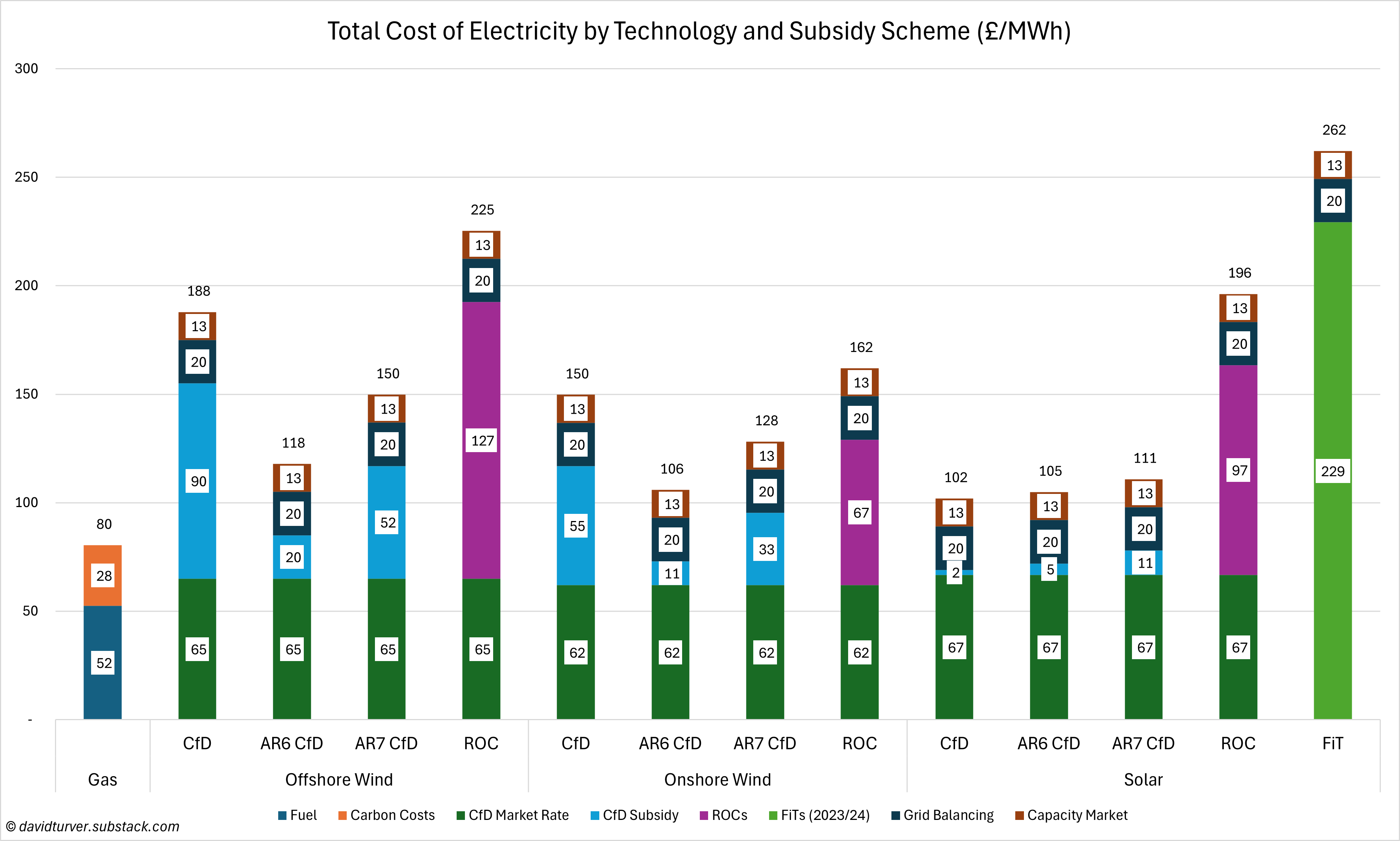
The basic cost of solar power from Feed-in-Tariffs is the most expensive renewable electricity we produce, costing £229/MWh in FY2024/25. The cost of grid balancing and backup needs to be added to that figure. Grid balancing adds about £20/MWh to the cost of intermittent renewables and backup from the capacity market about £13/MWh giving a total of £262/MWh, or more than three times the cost of gas-fired electricity, which is currently around £80/MWh including carbon costs of about £28/MWh.
ROC-funded-solar costs the market value of solar output, which has been around £67/MWh so far in 2025/26 plus an average of 1.44 Renewables Obligations certificates which have a buy-out value of ~£97/MWh, giving a basic cost of £163/MWh. Adding the grid balancing and backup costs gives a total of £196/MWh.
Many new solar farms have come online this year and have brought down the average strike price for active Contracts-for Difference in 2025/26 to ~£69/MWh, of which about £67/MWh is the market price and about £2/MWh is subsidies. This looks competitive until the extra balancing and backup costs are added, bringing the total to ~£102/MWh. It is unlikely that solar is going to get any cheaper, because new projects were awarded at £72/MWh in AR6, higher than the current weighted average, and 20-year index-linked contracts at £78/MWh are being offered in AR7. In short, the full cost of even the cheapest solar projects is more expensive than gas.
It should not come as a shock that the World Bank found the UK to be the second-worst country for solar in its Photovoltaic Power Potential report from 2020 (p31). Rory’s claims of cheap and affordable solar power can be seen to be manifestly false. He has obviously spent too much time with spinmeister Alastair Campbell.
Blowing a Fuse
The false claims of cheap solar power are not the only problems with this clip. To illustrate why, we must dig into the finances of Fuse Energy. Fuse is a relatively newcomer to energy supply, entering the market in the summer of 2023. We now have accounts for year-ended 31 December 2024, which also include the re-stated accounts for 2023.
A quick glance at the turnover reveals fast growth, with revenue going up from £1.9m in 2023 to £15.3m in 2024. However, losses are growing too, with the loss before tax going up from £5m in 2023 to £7.8m in 2024.
However, to judge the business properly, we also need to look at the balance sheet to see how well the company can absorb shocks. Regular readers will remember that Ofgem has set new rules governing the financial strength of suppliers to ensure they can cope with price shocks. All suppliers should have a minimum Capital Floor of £0 adjusted net assets per domestic dual fuel customer and be working towards a Capital Target of £115 adjusted net assets per domestic dual-fuel customer, or half that per meter point.
The picture for Fuse Energy is confusing because they present both a company and consolidated balance sheet. In the preamble to the accounts, they state they provide energy for 23,823 supply points. The company balance sheet shows negative net assets of -£0.28m. This means the company does not meet even the capital floor requirement. To meet the target capital they would need £1.37m of adjusted net assets, so they are £1.65m short or £69 per supply point.
The consolidated balance sheet looks in better shape, with net assets of £0.92m, so by this measure Fuse does meet the minimum floor. The consolidated balance sheet however, also falls short of the capital target by £0.45m or £19 per supply point.
However, this is not the whole story, because this analysis paints an overly optimistic picture. The consolidated group balance sheet records £14.2m of tangible fixed assets (of which £14.1m is plant and machinery). The vast bulk of these assets are plant and machinery for wind turbines and solar panels in the accounts of subsidiaries. These are recorded as investments in the company balance sheet, valued at £14.8m. The optimistic picture arises from how the assets are valued in the accounts, see Figure 3.
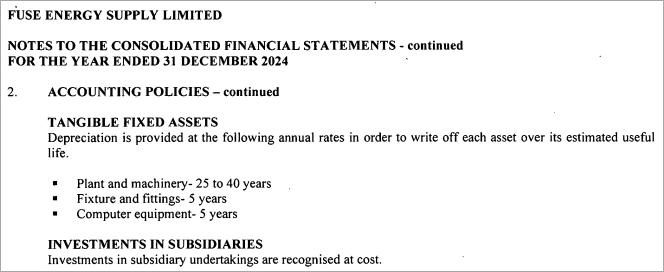
Crucially, investments in subsidiaries are valued at cost. The subsidiaries are disclosed as investments in four companies, see Figure 4.
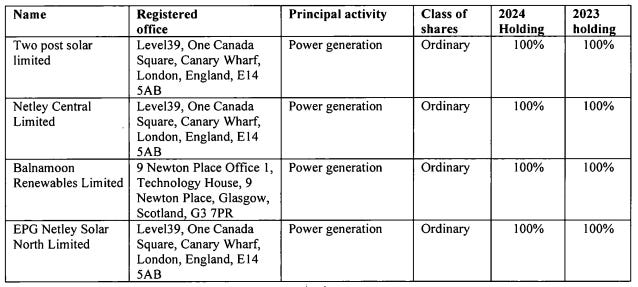
The companies are Two Post Solar Limited, EPG Netley Solar North Limited, Balnamoon Renewables Limited and Netley Central Limited. The first two are solar farms, Balnamoon is a single turbine wind farm and Netley Central is a new company incorporated in 2023 with negative net assets of just £2,579 in the latest accounts made up to 31 July 2024. The bulk of the assets are in the other three companies and the latest accounts of these companies have recently been published, see Figure 5.
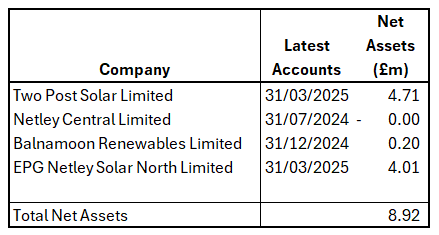
The total net assets for the subsidiaries are just £8.92m, some £5.2m less than the value of plant and machinery in the consolidated balance sheet and £5.9m less than the £14.8m value of investments in the company balance sheet.
By convention, if a business is acquired for a value greater than the net assets, the premium is recorded as goodwill in the balance sheet of the acquiring company. Of course, goodwill is an intangible asset and according to the Ofgem should be subtracted from net assets when calculating the adjusted net assets used when evaluating compliance with their capital targets. If we take this into account, Fuse becomes non-compliant with the capital floor on both measures and even further away from the capital target, see Figure 6.
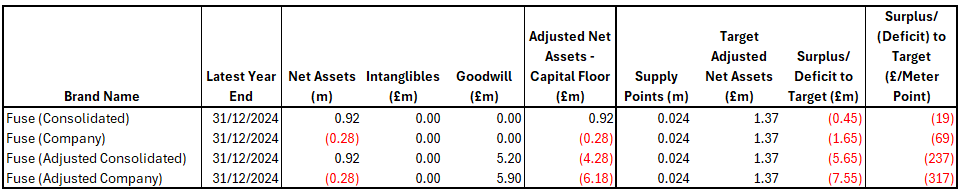
If we look at the consolidated balance sheet, Fuse is £4.28m short of the capital floor and £5.65m short of target. The individual company balance sheet is £6.18m short of the capital floor and £7.55m short of target.
According to Ofgem, companies that have adjusted assets below the target but above the floor are deemed to be in the intermediate position and be subject to transition controls until they have submitted a credible capitalisation plan. The transition controls include a sales ban, effectively stopping them taking on new customers. The sanctions for not meeting the capital floor should be even more stringent. It is staggering that Fuse is still touting for business on its website and through sponsorship of the Rest is Politics.
Fuse Energy have been approached for comment, but have not responded.
Conclusions
There is no real divide between Rory Stewart and Alastair Campbell when it comes to renewables and Net Zero. In fact, both have bought into the narrative hook, line and sinker. But as we saw in Campbell’s earlier incarnation, when narrative is elevated above facts, then the truth suffers.
It is simply not true that solar is a cheap and affordable way to generate electricity in the UK. We can safely say that Rory was at best mistaken when he claimed that solar is “very cheap and affordable way to generate electricity”. It is obvious that their central claim is misinformation, worthy of a Campbell propaganda machine.
It is even worse that The Rest is Politics has been sponsored to spout this propaganda by a lossmaking renewable energy company with a weak balance sheet apparently not in compliance with Ofgem financial resilience rules. Of course, Ofgem is now fully bought into the Net Zero narrative too, so is of course not enforcing its own rules. When facts are ignored and the truth is hidden then what is left is simply empty narrative and spin. Perhaps their podcast should be renamed as The Rest is Propaganda.
This Substack now has over 5,000 subscribers and is growing fast. If you enjoyed this article, please share it with your family, friends and colleagues. Please consider utilising the seasonal offer, open until 11 January 2026 and signing up for or gifting a discounted paid subscription
Stewart is an Oxford PPE graduate, Campbell is a Cambridge modern language grad. In other words both know the square root of FA about electricity but an awful lot about sounding like they do. That is for me the whole problem with British politics- dominated by people who all think/talk the same on the left and right.
There was a very recent interview between Stewart and Polanski. Stewart started by saying that he wanted to get an idea of Polanski's grip on 'the numbers'. His first question was "How big is the National Debt?". Polanski waffled, he obviously didn't know. After further questions it became apparent that Polanski didn't know the difference between National Debt and The Deficit. So I'm surprised that Stewart would consider voting green.