

Introduction
The Climate Change Committee (CCC) was asked by the Government to provide advice on the draft Heathrow Expansion National Policy Statement (HENPS) and has recently published its response. The document produced by the CCC also covers broader Net Zero policy towards aviation.
Unsurprisingly the CCC, or as we should now call them, the Energy Facts Committee(!), say there is insufficient policy in place to decarbonise aviation. The CCC claims that under current policy aviation emissions would not fall from 2025 levels by 2050.
As we might expect, the CCC decided that Heathrow expansion cannot go ahead without requiring the aviation industry to reduce emissions. They set out draconian policies to rein in aviation emissions by 2050 and recommended the cost of these policies fall on air passengers. For example, the CCC say £150 will be added to the cost of a return flight to Alicante and £400 will be added to the cost of flying to New York and back. This means the CCC wants to make your holiday more expensive. Time to take a look at the feasibility of the CCC plans and what lies in store for air travellers if they get their way.
Inconsistent Metrics
The first thing to note is that there is an inconsistency in the aviation metrics used by the CCC in the Seventh Carbon Budget (CB7) and in this latest report. In CB7 they used distanced travelled by plane per capita and overall airport terminal passengers, as shown in Figure 1 (from Tab 7.6.3 of the charts and data workbook).

These charts show both distance travelled per capita and airport terminal passengers growing out to 2050. We will come to the cost of synthetic aviation fuel later.
In the Heathrow Expansion they sometimes use slightly different metrics and give a different picture. The full dataset for the HENPS full dataset (key variables tab) uses overall passenger kilometres travelled instead of passengers per capita. By indexing both figures, setting the 2026 value to equal 100, we can see the difference in assumptions, see Figure 2.
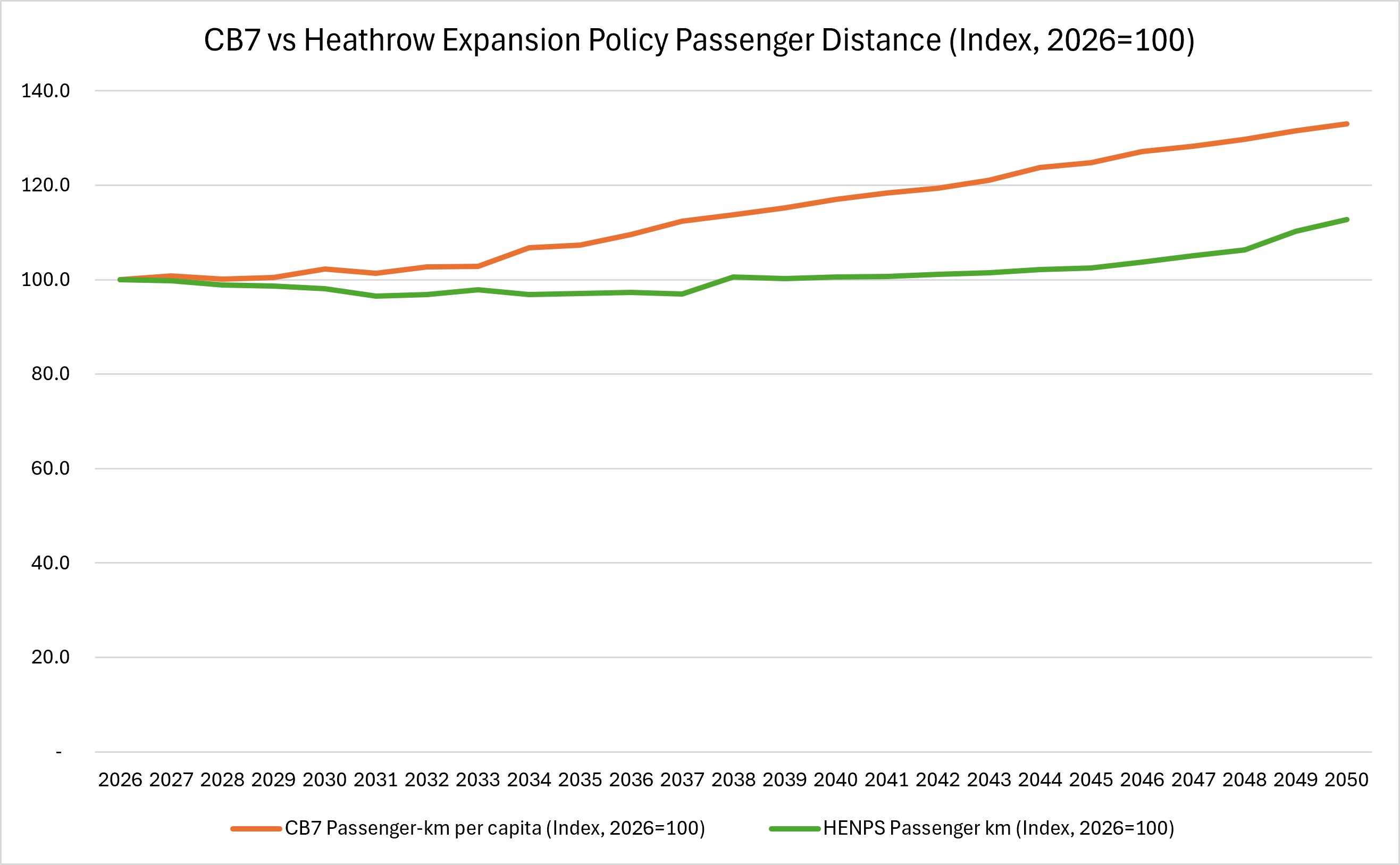
In CB7 the CCC expected passenger-km per capita to rise by 33% from 2026 levels by 2050. Now they expect total passenger-km to rise by just 12.7% by 2050. Either they have cut their forecasts for air travel quite dramatically, or they are expecting a big decrease in population.
In Figure 3, we can see that it is airport passenger numbers they expect to fall compared to CB7.
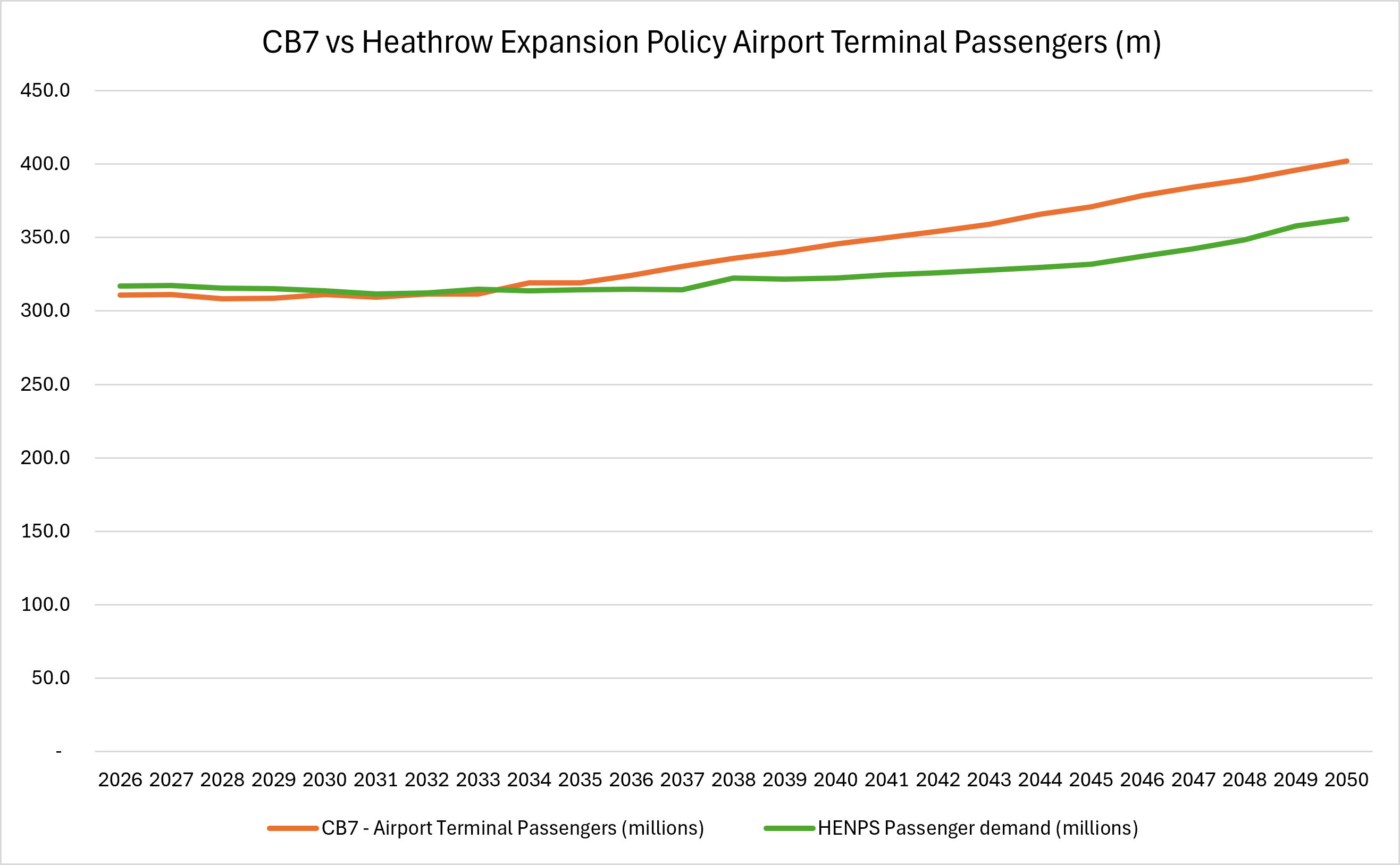
In CB7 published in 2025, the CCC expected 311m airport terminal passengers in 2026. In HENPS, they now expect over 317m passengers in 2026. However, the growth projections for 2050 have fallen dramatically. In CB7 they expected 401.9m passengers in 2050, now they expect just 362.5m, a cut of 9.8% to the earlier forecast. We can see already they expect their recommendations to reduce demand for air travel significantly.
The Aviation Net Zero Pathway
The CCC analyses the balanced pathway by measuring the change arising from their forecast baseline by making changes to demand, improvements in efficiency, introducing sustainable aviation fuel (SAF) and from what they term engineered removals, by which they mean removing and storing carbon dioxide from the exhaust gases of biomass plants (CCS) or direct capture from the atmosphere (DACCS).
Baseline Changes
The baseline for aviation emissions in HENPS has changed somewhat compared to what was assumed in CB7. In CB7 they assumed the baseline emissions in 2025 were 37.2MtCO2e, the HENPS assumption for 2025 is slightly lower, but still rounds to 37.2MtCO2e. However, CB7 forecast 54.4MtCO2e of baseline emissions in 2050, compared to the 61.1MtCO2e assumed in HENPS, a 12.4% increase. This makes the task of getting to Net Zero harder because there are more emissions to abate.
It is difficult to reconcile reduced passenger-km and passenger numbers in HENPS vs CB7 with the higher expected emissions.
Increase in Prices to Reduce Demand
CB7 assumed 9.5MtCO2e of emissions reduction compared to baseline between 2025 and 2050 coming from “managing aviation demand growth”. They said their analysis assumed that the aviation industry taking on the cost of decarbonisation will help manage demand. In other words, they are planning to make flying more expensive so fewer people can afford it.
In HENPS they assume even more of the emissions reduction, some 14.6MtCO2e will come from demand management, this represents about 24% of the total emissions reduction from the baseline. They say: “most policies would operate by changing the price of flying, which is how they are modelled in this analysis.”
In fact, in the HENPS report they say they expect ticket prices for a return trip to Alicante will rise by £150 and a return trip to New York will go up by £400. A quick look at the Ryanair website reveals a return trip from London Gatwick to Alicante flying out on 5 October and returning on 14 October 2026 can be found for a price of £47.98, so they are planning on quadrupling the cost of a return flight to Spain by 2050. The cheap flights website shows a return flight from Heathrow to JFK in New York, travelling out on 8 October and returning on 15 October can be purchased for £375. So, the CCC wants to more than double the cost of a return flight to New York. There can be little doubt they are deliberately trying to make foreign holidays much more expensive. This comes on top of Prime Minister Burnham’s proposed holiday tax on hotel stays in Britain, so domestic holidays are going to increase in price too. Poorer families are going to be priced out of both domestic and foreign holidays.
Sustainable Aviation Fuel
We can see where the some of the cost increases and hence demand management measures are going to come from by looking at the plans for Sustainable Aviation Fuel (SAF). CB7 assumed 13.1MtCO2e of emissions reduction compared to baseline between 2025 and 2050 would come from replacing kerosene with Sustainable Aviation Fuel (SAF). They assumed 6% of total aviation fuel would be met by SAF in 2030, 17% in 2040 and 38% by 2050. They also assumed SAF would cost 34.93p/kWh in 2035, falling to 28.88p/kWh by 2050.
In HENPS they assume slightly less emissions reduction from SAF, some 12.1MtCO2e. This represents about 19.7% of the total emissions reduction from the baseline. They envisage that SAF will come from a mix of biofuels and synthetic fuels (combining low-carbon hydrogen and a source of captured carbon, also called power-to-liquids. In HENPS, they are silent on the cost of SAF, but they see the cost of carbon in the UK Emissions Trading Scheme to rise from £41/tCO2e in 2026 to £657/tCO2e in 2050.
However, the CCC’s plans are riddled with unrealistic assumptions. First, airline chiefs have poured cold water on the SAF targets. Michael O’Leary, boss of Ryanair has said aviation sustainability targets are “dying a death” and the sector will miss both the 2030 targets for SAF and the overall 2050 Net Zero mandate. He added that he thought SAF was a nonsense. Willie Walsh, the former head of BA and now director general of IATA has said that governments had targeted a 5% emissions reduction by 2030 using SAF but “there is no path to meet that outcome”. He added that hope for meeting the Net Zero target by 2050 was “fading fast.”
Second, the CCC’s cost assumptions for carbon prices and SAF costs are frankly ridiculous. The table below sets out the impact of current policy and the CCC aviation pathway on fuel costs. The starting point is the elevated price of jet fuel at $185.43/bbl from IATA for September 2026.
This equates to a basic fuel cost of £0.88/l. Large airlines must pay carbon costs through the Emissions Trading Scheme and using the CCC’s assumption of £41/t for 2026, gives a cost of £0.10/l, giving a total jet fuel cost of £0.98/l meaning carbon costs increase the basic fuel costs by 11.9%. If jet fuel prices return to 2025’s more normal $100/bbl, then the basic cost would be just £0.47/l and the fixed carbon costs would add 22%, giving a total cost of £0.58/l. The analysis below uses today’s $185.43/bbl cost of jet fuel and the numbers in brackets indicate the values if jet fuel prices return back to $100/bbl.
The Government has set a buy-out mandate price cap of £4.70/l for biomass SAF and £5/l for power-to-liquids SAF. The biomass SAF price cap is some 5.4 (9.9) times the cost of today’s elevated conventional fuel cost. The SAF mandate says airlines must use 3.6% SAF in 2026. This makes the blended average cost of aviation fuel £1.11/l (£0.73/l), some 27.1% (53.4%) above the basic fuel cost. Net Zero is already pushing up the costs of air travel.
In their Net Zero Aviation Pathway, the CCC assumes carbon prices will rise to £657/t by 2050. This would add £1.67/l to the basic cost of jet fuel and push the carbon-loaded cost up to £2.55/l (£2.14/l), a 190.3% (353%) increase on today’s basic fuel price.
The CCC assumes the cost of SAF will fall 41% to £28.88p/kWh or £2.77/l by 2050 and CB7 says that SAF will be 38% of total fuel. This would give a weighted average fuel cost of £2.63/l (£2.38/l) or 200.2% (403.6% above today’s basic fuel cost (excluding carbon costs).
It is clear the CCC want to use carbon costs and SAF to dramatically increase the cost of jet fuel. Their assumptions mean jet fuel will cost about 3 times current levels or 5 times 2025 levels by 2050. This will have a dramatic knock-on impact on airfares and significantly reduce demand.
Impact of Engineered Removals
Increasing carbon taxes and mandating SAF are not the only things that are going to push up airfares. In HENPS Engineered Removals are the largest single driver of emissions reduction.
CB7 assumed 22.7MtCO2e of emissions reduction compared to baseline between 2025 and 2050 coming from engineered removals. In HENPS they assume engineered removals will contribute 21.9 MtCO2e or 35.9% of the total emissions reduction from the baseline. But how realistic is this plan?
They say engineered removals could come from with bioenergy with carbon capture and storage (BECCS) or from direct air carbon capture and storage (DACCS). Both technologies are in some considerable doubt. First, in their 2025 annual report Drax announced that its BECCS project was unlikely to proceed and wrote off the spending to date of £47.6m saying:
“Whilst UK BECCS is still an attractive option for the Group in the long term, the current political environment and absence of an appropriate regulatory framework has led to a reduction in the likelihood of the project proceeding in the short- to medium-term. Accordingly, the capitalised value has been impaired.”
In other words, they no longer think they will get enough subsidy to make BECCS viable. Second, there are very few DACCS projects operating globally and those that exist are tiny. DACCS is a hugely energy intensive process cheap energy is essential to make it work, something the UK is sadly lacking. The extortionate carbon prices assumed by the CCC will be required to make DACCS look superficially economically attractive. The flagship Icelandic Climeworks Mammoth project has allegedly failed to capture enough carbon to cover its own emissions. Even Climeworks’ earlier, smaller Orca plant has never consistently met its carbon removal capacity. The Orca plant was designed for a nameplate capture capacity of up to 3,000 tons of carbon per year but has only managed to capture about 1,000 tons.
In other words, the CCC’s Net Zero pathway for aviation relies on expensive and unproven removal technologies for more than one third of the emissions reduction target. They also expect airlines, who will pass this cost on to passengers, to pay for this rainbow and unicorn technology.
Efficiency Improvements
Partially offsetting the increase in costs above, efficiency improvements should reduce costs somewhat and also reduce emissions. CB7 assumed 9.1MtCO2e of emissions reduction compared to baseline between 2025 and 2050 would come from efficiency improvements. These include improvements in jet engine efficiency and operational improvements plus the introduction of battery-electric hybrid aircraft.
In HENPS they assume even more of the emissions reduction, some 12.5MtCO2e will come from efficiency improvements. This represents about 20.4% of the total emissions reduction from the baseline. They now seem to have dropped the CB7 idea of hybrid aircraft, perhaps acknowledging unfeasibility of these aircraft after Dale Vince pulled the plug on his Ecojet venture that planned to become the first all-electric airline using hydrogen-electric power trains.
Conclusions
Last week’s article covered the machinations of the Energy Security and Net Zero Committee that lamented the fracturing of the Net Zero consensus. ESNZ wanted a rebrand of Net Zero to the energy transition and “benefit-led” messaging from a renamed “Energy Facts Committee”. A week later the actual CCC advice is that holidays should cost much more, demand should be suppressed, and a third of their aviation pathway depends on removals that Drax will not build and Climeworks has not delivered at scale. If those are the energy facts, the public is entitled to hear them before the rebrand.
These facts will not stop them trying, and consumers will suffer hugely as a result. Be in no doubt the CCC is coming for your holiday.
I would like to encourage readers to sign this petition calling for Net Zero to be suspended until a full impact assessment has been carried out.
Eigen Values now has over 5,800 subscribers and is growing fast. If you enjoyed this article, please share it with your family, friends and colleagues. Please consider signing up for or gifting a paid subscription.
The CCC might actually have a point on aviation emissions, but not for climate reasons!
I’ve been re-reading Richard Lyon’s Substack posts on “The Energy Trap”, prompted by his recent appearance on the Climate Sceptic Podcast “Have we hit peak oil yet?” which is well worth watching: https://www.climateskeptic.org/p/the-climate-skeptic-podcast-episode-51e.
His concise and layman-friendly book of the same title is now available on Amazon and must rank as one of the most important ever written on energy policy because what he discloses is far, far worse than popular understanding.
It’s an uncontroversial 2½-hour read because he skips over the irrelevant vexatious science of climate change and “conspiracies theories” on why such obviously failing and unilaterally pointless Net Zero energy policies are being pursued with such political fanaticism while disallowing any meaningful public debate.
He concentrates instead on the physics, chemistry, geology and economics of energy, quoting fictional Scottie of the USS Enterprise with “Ye cannae change the laws of physics”. His technical background and senior role 25-years in the oil and gas industry have combined to make him ideally suited to author such an eye-opening work.
He points out that every past human technological advance – wood to coal, coal to oil, oil to nuclear - has been to adopt a superior technology whereas the Net Zero “transition” is a retrograde step to rely on low-quality (low-ERoEI, Fig 4 in the book) energy sources like wind and solar and low-quality energy carriers like lithium-ion batteries and hydrogen (Fig 1 in the book).
These past advances have relied on the old technologies being available to build out the new technologies whereas the “Just Stop Oil” fantasy mindset of the 2050 Net Zero transition is to dispense with the old technologies and rely on the ineffective new weather-dependent short-lifespan low-quality energy technologies which in the real world can only be built (and replaced every 20 or so years) with the heavy-lifting support of hydrocarbons.
Further to the Net Zero fantasy, he notes that about a third of all hydrocarbon use today is as feedstock in the production of the four essential pillars of modern industrial economies - steel, cement, ammonia and plastics – and that trying to produce these by any other means is not a feasible option.
Most importantly, he claims that the falling discovery rate of new economic oil resources indicates that “peak oil” happened in 2006 causing a price spike which was probably the main underlying cause of the 2008 financial crisis. He warns that we should be conserving our limited reserves rather than squandering them (on flights to Alicante?) as we are doing now. He asserts that a prompt transition to cheap prolific nuclear power and the electrification of as much as possible is the only way to avert the existential energy trap now staring us in the face.
Don’t forget that Net Zero was cooked up by the United Nations which is not exactly a “centre of excellence” authority on global energy policies. Their 2019 infamous, obviously infeasible 1.5° Special Report stated “Global net human-caused emissions of carbon dioxide (CO2) would need to fall by about 45 percent from 2010 levels by 2030, reaching ‘net zero’ around 2050. This means that any remaining emissions would need to be balanced by removing CO2 from the air”.
For reasons only they can explain, our technically-challenged Uniparty politicians gleefully adopted the UN’s fatally-flawed Net Zero policy, apparently without understanding its inevitable deeply destructive consequences and apparently now oblivious to the fact that we could be facing civilisational collapse within a relatively short time if we don’t do something about it.
Much of the blame for this catastrophe must lie with our energy industry professionals, most of whom (e.g. BP with their delusional excursion into the windmill business) have meekly gone along with the UN’s cynically-manipulated Net Zero “consensus” to lead us racing lemming-like towards the energy trap cliff-edge: https://www.conservativewoman.co.uk/wp-content/uploads/2023/11/net-zero-nonsense.jpg.
It’s great that Richard has articulated the dire state of our energy policy so clearly. Hopefully our delinquent politicians will belatedly take note. Richard Lyon for Energy Secretary!
I am sorry to say this but you are 100% WRONG in your assumptions, the CCC are NOT after your holiday……..you did not include the wonderful, innovative work the CCC have done on the Great British Holiday. Two weeks each year at a holiday camp, preferably next to the coast, sites are currently being looked at, there is a urgency here as the Home Office also want these as temporary permanent accommodation for new arrivals by unauthorised means.
The CCC want you to enjoy living in a 10x8 luxury cabin, accommodation for maximum of 6, supplementary charges for below, wake up each morning at 0600hrs to the sound of the Victory bugle, two hours of callisthenics, then the communal showers for a vigorously refreshing cold shower (towels, soap, shampoo not provided), then off to the Victory cafeteria for a nourishing breakfast of one egg, one tomato and one slice (unbuttered) of toast, all from the Victory farms. Then it’s education time- two hours of CCC economics, special attention to be paid to the section “Freedom and Justice Whose Money Is It”, at 1100hrs the first Hate session is scheduled, this will be part 1 of six daily re education sessions where the people will learn to hate those who are against US!- session one- Hate Freedom of Thought, session two- Hate Freedom of Movement outside of your designated zone, session three- Hate Fossil Fuel as it has set the land, sea and air of FIRE, session four- Hate Israel for standing up to terrorism, session five- Hate Farage and all those who do not BELIEVE, and session six- Hate the West and its misleading education system, especially its failure to understand history. Then at 2000hrs whilst singing the Victory anthem and declaring love and praise for our glorious leader, Andy, Andy, Andy, you will be embraced by the love of your fellow inmates/prisoners/campers/holidaymakers. Then it’s off to the Victory theatre to watch “Andy and how I saved the World” with rolling updates across the screen of the pig iron, wheat, barley, potatoes produced in this the fifth 10yr plan, note carefully how each year production has nearly tripled, and that the World is starving, war torn and pitilessly killing itself whilst WE are living in a Free, Democratic Republic especially now we have got rid of useless voting. Don’t forget that today Victory Beer at 0.25%adv and Victory Gin at 5.0abv are on Special Offer to get the Victory Party started, ration limit two units.
Victory is OUR’S, God bless Net Zero, it has given us the chance to live miserable lives, with no hope, in a open air prison, where nothing works, everything is too expensive and the greatest crime is too think……..where can I get a boat to escape this hell hole.