

Peak Pink Octopus
Separating Kraken and regulatory woes may indicate that Octopus Energy has peaked.
Introduction
Octopus Energy Group has been in the news recently, floating the possibility of separating its Kraken Technologies unit. It is suggested that Kraken might be worth £10bn and the whole group some £15bn. This valuation of the whole group is more than double the valuations achieved in the latest equity fund raising rounds in May and June last year which valued the company at $9bn, or about £6.7bn at recent exchange rates.
Octopus has also been in the news for not holding as much cash in the bank as Ofgem rules say it should. The boss of Centrica, Chris O’Shea, reckons Octopus are holding about £1bn less cash than they should and that represents a systemic risk to the market. Octopus appeared to acknowledge the shortfall but said it remained on the right side of regulations because it has agreed a path to compliance with regulators. O’Shea thinks Octopus should not be allowed to take on new customers until it has rebuilt its cash pile.
Octopus Energy is privately owned and it would not be unusual for private equity owners to puff up the value of their investments prior to sale to maximise their returns. These lofty valuations often indicate market peaks and separating Kraken now might be a way of meeting the cash shortfall instead of investors stumping up yet more capital. CEO of Octopus Energy, Greg Jackson has recently gone on record saying “companies that set out to deliver on the fundamentals are more relevant now than ever before”.
So, how do the fundamentals of Octopus stack up, or is this demerger of Kraken a signal we have reached peak pink Octopus?
Octopus Energy Group Operating Performance
Octopus Energy Group Limited (OEGL) is a sprawling empire with dozens of subsidiaries across the energy sector. The largest subsidiary, Octopus Energy Limited is perhaps best known as a UK energy supplier with the pink Octopus logo. The group also of course includes Kraken Technologies which provides customer management software and applications to manage remote technologies like electric vehicles, solar panels, heat pumps and batteries. There is also an Octopus Generation arm which owns some wind turbines and manages funds investing in renewable energy. Octopus Electric Vehicles provides EVs, Octopus Electroverse provides EV charging software, Octopus Energy Services installs heat pumps, solar panels EV chargers and so on. Finally, we have Octopus Energy Heating that researches and makes heat pumps.
The group has shown explosive growth with revenue growing from just £477m in year ended April 2019 to £12,433m in 2024. Much of this growth has been achieved through acquisition, with the group acquiring Avro Energy in 2021, Bulb in 2022 and Shell’s energy supply business in 2024. Kraken and the other subsidiaries have also been acquisitive.
However, as Figure 1 shows, the OEGL has not been very profitable.
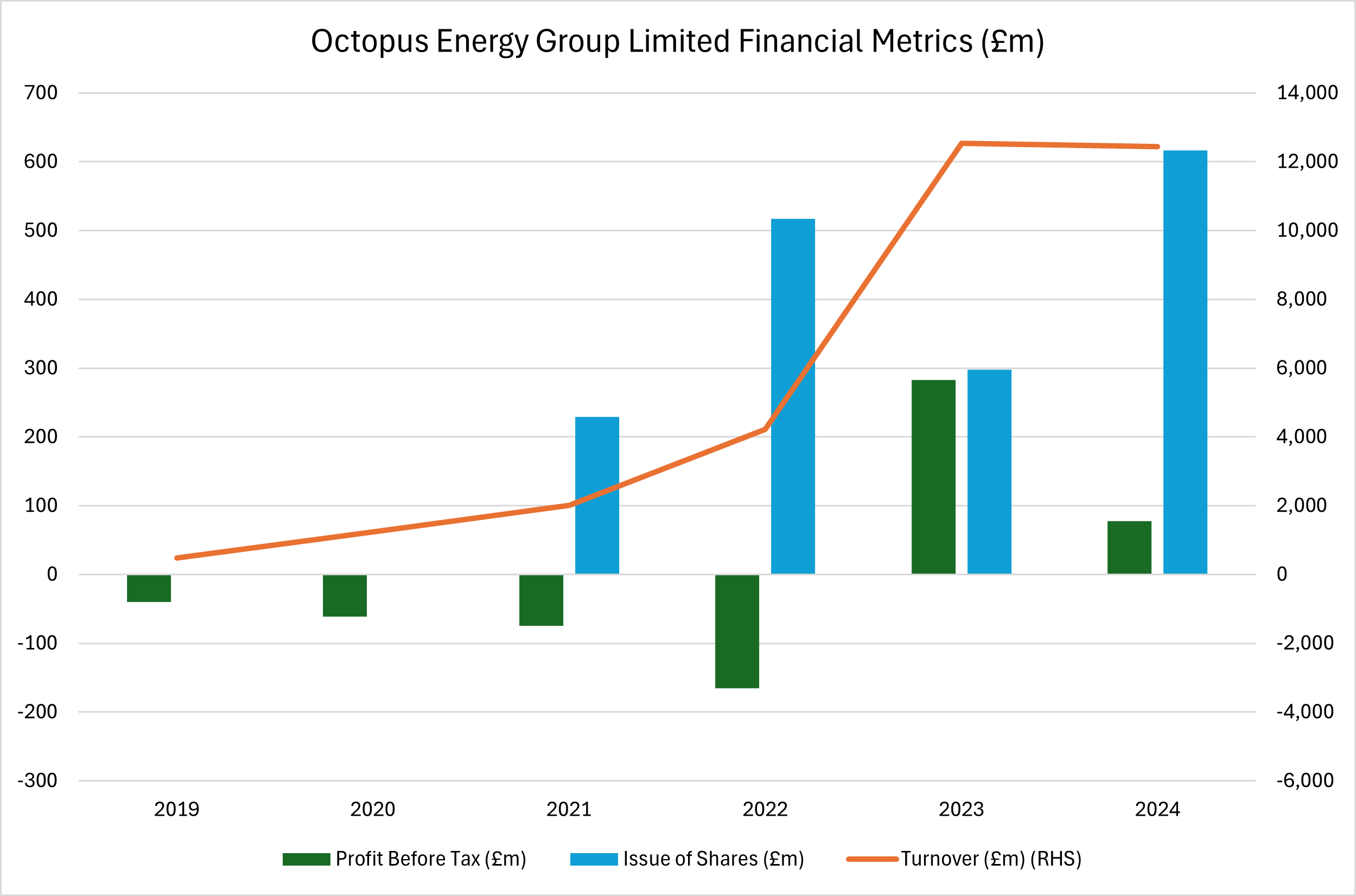
As turnover rose sharply (orange line) to £4.2bn in 2022, losses before tax (green bars) grew from £39.9m in 2019 to £165.7m in 2022. The energy crisis and acquisitions saw turnover explode to £12.5bn in 2023 and probably helped the group generate a profit before tax of £283m, but profits fell back to just £77.6m in 2024 as revenue fell slightly to £12.4bn. However, the whole group generated just £31.4m cash from operations in the April 2024 accounts. At that rate it will take quite some time to cover the alleged £1bn shortfall.
The explosive growth has been funded by large injections of share capital (blue bars) totalling £1,661m from various shareholders including Australia’s Origin Energy, Tokyo Gas, the Canadian Pension Plan Investment Board and Al Gore backed Generation Investment Management. Galvanize Climate Solutions and Lightrock also made investments after the 2024 year-end of an undisclosed amount. OEGL’s original backer and largest shareholder was Octopus Capital. However, their shares are now held through OE Holdco that has a long list of shareholders including the family members of people connected to Octopus Capital.
We might speculate that the investors are not keen on providing additional capital to satisfy regulatory requirements and are now keen to see a return on their investment. However, £15bn seems like quite a racy valuation for a company with such a patchy record of profitability and stagnant revenue. At first glance, the fundamentals look a little shaky, but now let us take a look at the most significant subsidiaries.
Kraken Technologies
The jewel in the crown of OEGL is Kraken Technologies. This subsidiary has seen explosive growth. Revenue has also grown strongly from £10.2m in 2019 to £136.3m in 2024, but profits have been patchy with profits before tax growing from £9.4m in 2019 to £49.5m 2022 before plunging to £20.8m in 2023 and then recovering to £45.8m in 2024.
Live accounts on the platform grew from 1.4m in 2020 to 32.8m in 2024. Contracted accounts have grown from 24.3m in 2022 to 50.5m in 2024 and the Sky article linked to above claims 70m accounts are now contracted with a target of 100m contracted accounts by 2027. Growth in the number of accounts has been flattered somewhat by transferring on to the platform the accounts of Avro, Bulb and Shell after acquisition. Moreover, the 4.2m customers of investors Origin Energy and 3m electricity customers from fellow investor Tokyo Gas have also been migrated on to the Kraken platform.
The growth in the accounts with patchy profitability leads to some interesting operational metrics as shown in Figure 2.
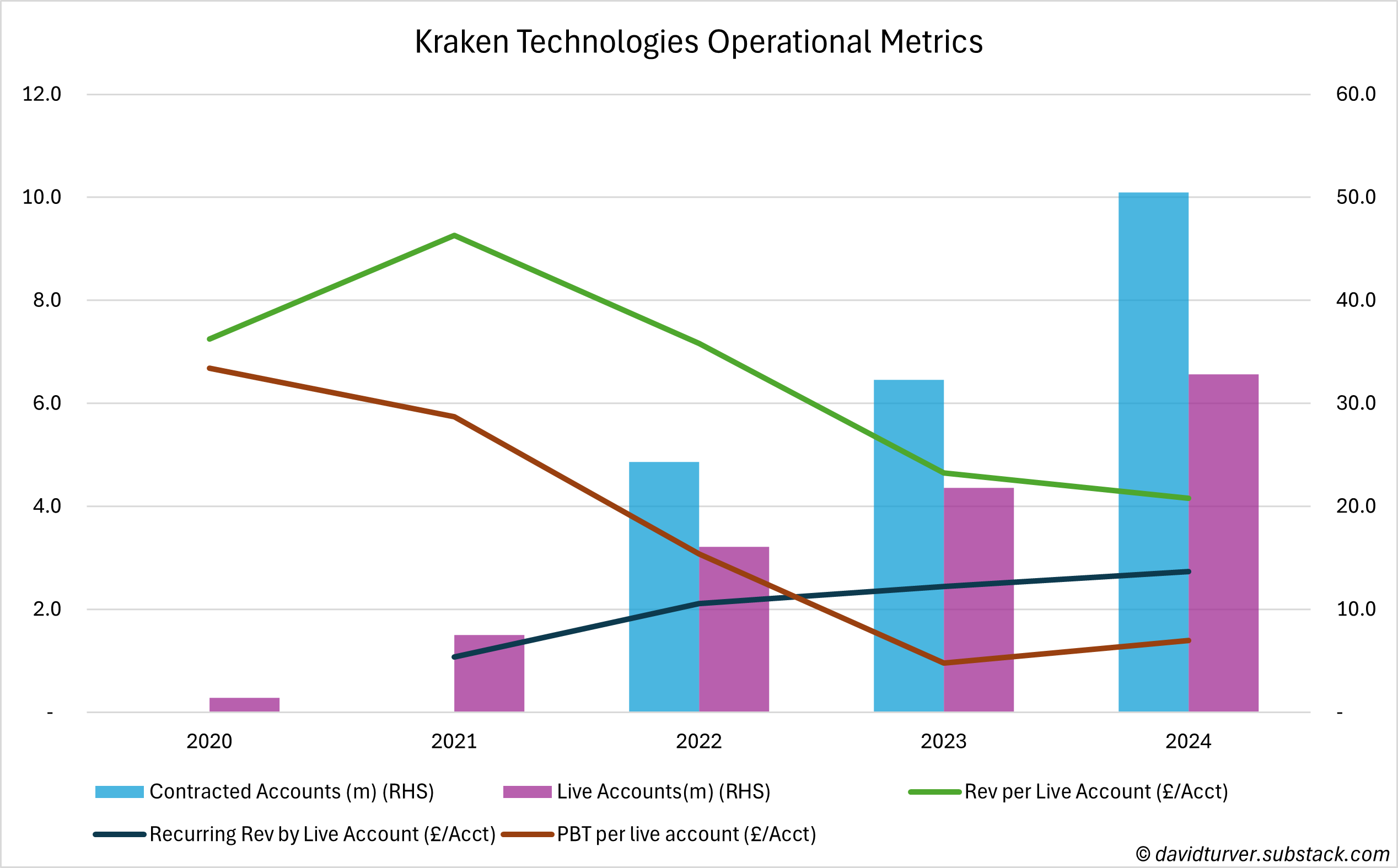
As the number of accounts has grown, total revenue per live account has fallen alongside profit before tax per live account which was £1.40/account in 2024. On the positive side, recurring revenue per live account has risen from £1.10 in 2021 to £2.70/account in 2024.
On the face of it, this is an attractive growth business. However, if they achieve 100m live accounts by 2027, and achieve the same £1.40/account in pre-tax profits, then the mooted £10bn valuation would imply a forward price/earnings ratio of over 70, which is more than a little racy. We should wish them luck in persuading investors to part with their money at that valuation.
Octopus Energy
The main energy supply business of Octopus is called Octopus Energy Limited (OEL) and analysis if this company is somewhat tricky. The energy crisis, the various acquisitions and moving around of subsidiaries makes like-for-like comparisons difficult. However, we can note that OEL made losses in years ended 2019, 2020, 2021 and 2022. There were profits before tax in 2023 of £227m which fell to £204m in 2024. However, the £46.7m operating loss by the subsidiary that runs the former Bulb operations should probably be deducted from that figure because it was apparently then still directly owned by OEGL.
We will have to wait for the 2025 or even 2026 accounts to get a clearer view of the profitability of this part of the Octopus empire as the acquisitions bed in. However, Greg Jackson has recently posted on X that Octopus loses money on energy retail (see Figure 3).
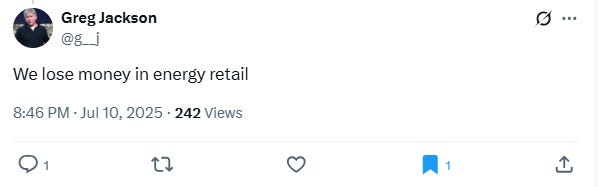
Maybe the fundamentals of paying solar customers 15p/kWh (or £150/MWh) for their exports when the current wholesale rate is less than half that are not so great. The strategy of sometimes paying Agile customers to use electricity has bad fundamentals too.
Moreover, there are signs that customer service might be slipping and Kraken might be cracking because anecdotally, the number of complaints about Octopus on X seems to be growing as the example in Figure 4 demonstrates.
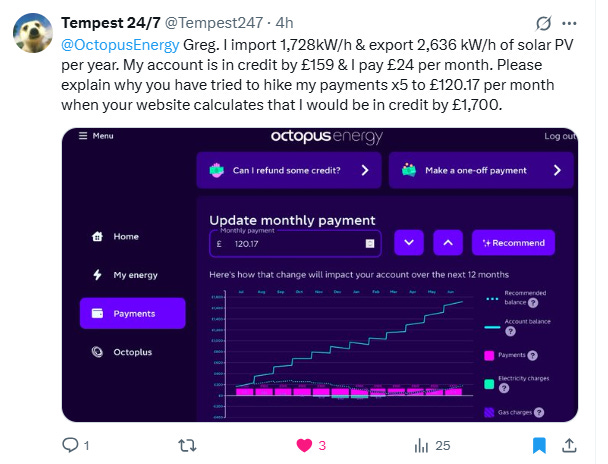
It certainly does not look like the fundamentals of the main energy retail supply business are particularly great.
Octopus EVs
The fundamentals of Octopus Electric Vehicles (OEV) are even worse, see Figure 5.
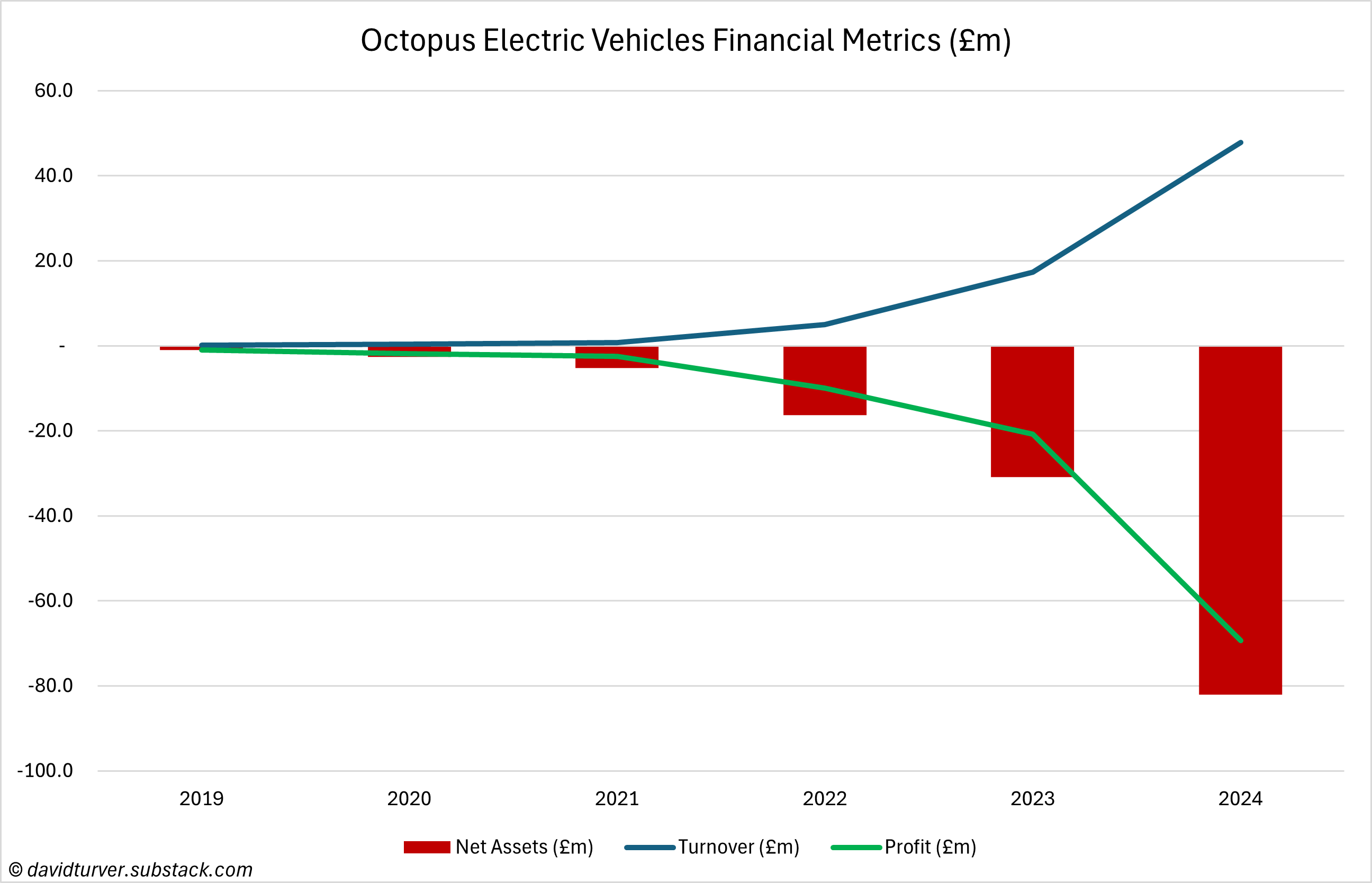
Every year since 2019 OEV has lost money. In fact in each and every year, the business has lost more money than it has taken in revenue. Things got so bad, in 2024 they had to restate their accounts for 2023. The persistent losses have led to net liabilities ballooning to £82.1m by 2024.
They say the increased losses are a result of “continued investment into the growth of the business” but do admit that there has been “volatility in electric vehicle residual values.” In other words, the second-hand value of the EVs they are leasing out has fallen through the floor and they are taking a bath. They say the EV salary sacrifice scheme is a big driver in the growth of their fleet. This scheme allows employees to pay for their EV out of their pre-tax salary, reducing their income tax and National Insurance contributions. Employers also benefit from lower employer NI contributions. That means that all of us are paying indirectly for OEV to destroy capital.
It remains to be seen whether the recent announcement of a partnership with BYD to combine an EV with free charging for under £300/month will do anything to improve a business with so far abysmal fundamentals. The small print (see Figure 6) that requires you to keep your car plugged into the charger for 12 hours a day for 20 days per month, so they can send power to the grid might put off a lot of users.

Octopus Energy Services
Octopus Energy Services is another division that is also rather adept at losing money. This company installs heat pumps, chargers, smart meters, solar panels, batteries and so on. This company had net liabilities of £50.8m in 2024, up from £9.1m in 2023.
The company posted revenue of £165.4m in 2024 and managed to make a pre-tax loss of £58.3m. This loss came despite receiving over £8m of grant income to install heat pumps and EV chargers. Octopus Electroverse also loses money.
Again, the fundamentals are not looking very sound.
Octopus Energy Heating
We now come to Octopus Energy Heating that conducts research and development for low carbon heating, trying to drive down the cost of heat pumps. This company does not report any turnover but made a loss of £6.1m in 2024. Net liabilities were £8.2m. This company also apparently owns Octopus Energy Production (formerly known as Renewable Energy Devices), a Northern Irish company that makes the Octopus Cosy heat pump. This company does not publish a Profit and Loss account, so we do not know the turnover, but the balance sheet shows net liabilities of £1.26m in 2024.
In 2021, Clem Cowton Octopus’ Director of External Affairs claimed that by 2022 (see Figure 7) their heat pumps would cost the same as gas boilers.
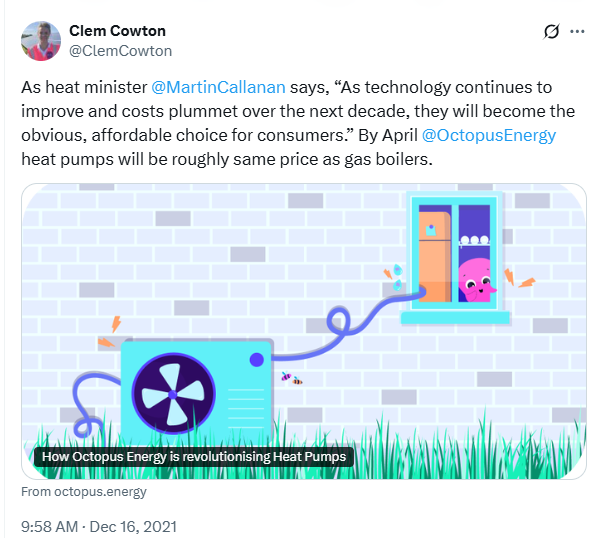
The claim has not been made recently and if it were true you might think that their heat pump arm would have started to make some money. The outlook is not great because Jason Cassells, who Octopus previously lauded as their heat pump expert, had his directorship terminated at the end of 2024.
Centre for Net Zero
Octopus also owns its own captive think tank, the Centre for Net Zero (CNZ). In the 2024 accounts, this division generated revenue of just over £0.5m but managed to post a pre-tax loss of £0.9m. However, Octopus might view this as a good strategic investment because Lucy Yu, CEO of CNZ is also well ensconced in the Green Blob. Ms Yu is a member of the Ed Miliband’s Clean Power 2030 Advisory Commission and is also a non-executive director of climate change think tank E3G.
Octopus Energy Generation
Finally, we move to Octopus Energy Generation which is the part of the Group that manages green energy generation. They own some of their own generation assets, but the main activity is investment management. They say there are seven funds that are closed for investment and a further four funds that are open for investment:
Octopus Renewables Infrastructure SCSp (aka Sky Fund)
Octopus Energy Offshore Wind SCSp
Octopus Energy Transition SCSp
Octopus Renewables Infrastructure Trust Plc (ORIT)
The first three funds appear are quite secretive and performance data has proven impossible to find. However, we do know the Sky fund had raised £1bn by November 2023 and had a target of raising £3bn by 2025 but there is no record of the fund reaching that target yet.
However ORIT is publicly traded and the performance data leaves more than a little to be desired as seen in Figure 8.
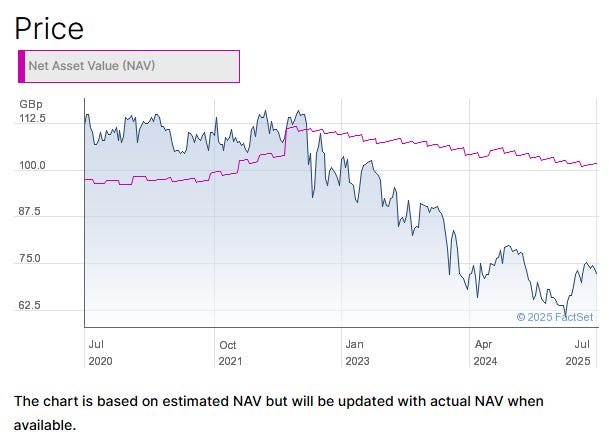
Over the past five years the share price has fallen 35% and the shares have moved from trading at a premium to the estimated Net Asset Value (NAV) to a discount of about 28%. After trending upwards the NAV is now showing a steady downtrend. If the other funds are making similar investments, the investors may be beginning to lose patience.
Conclusions
Greg Jackson was certainly right in saying the fundamentals of a company matter a great deal. Sadly, aside from Kraken, there is precious little evidence the fundamentals of Octopus are in good shape.
In recent years, it has become commonplace for private equity investors to seek an exit just as the value of their companies peaks. The timing of this separation of Kraken just as Octopus starts to come under scrutiny for not meeting Ofgem’s cash balance rules on time makes this transaction look doubly suspicious.
The £10bn valuation of Kraken looks more than a little ambitious, but the valuation of the rump Octopus business at £5bn looks ridiculous. The Chief Executive says they do not make money on the core business and the forays into other areas like EVs, heat pumps and installations look like they have been disastrous from a financial perspective. There is not enough data to form a definitive view of the fund management business, but the performance of ORIT does not give confidence that the other funds are performing well.
It certainly looks like the pink octopus is past its peak.
This Substack now has well over 4,300 subscribers and is growing fast. If you enjoyed this article, please share it with your family, friends and colleagues and sign up to receive more content. I would be grateful if more people would sign up for a paid subscription, so for a limited time I am offering a discount off annual subscriptions.
What you can be sure of is that the people running these loss makers will be taking plenty of money out for themselves and undertaking financial engineering so they don't pay any corporation tax.
The funds other than the trust are all conveniently domiciled in Luxembourg!!
Also as an aside all of the UK listed investment trusts in the wind, solar and battery space have done pretty disastrously over last 18mths with some at over 40% discount to (alleged) net asset value. Many of them did very nicely out of the 2022 power spike which made them look viable but reality has set back in even with the ROC/FiT largesse.
Kraken analysis!