

Labour's Energy Bill Shell Game
Shuffling costs cannot hide the increasing costs of renewables.
Introduction
At the time of the election, the Labour Party was promising a £300 reduction in energy bills. In last Autumn’s budget they cut this pledge in half by claiming to be reducing energy bills by £150 from April (see Figure 1).
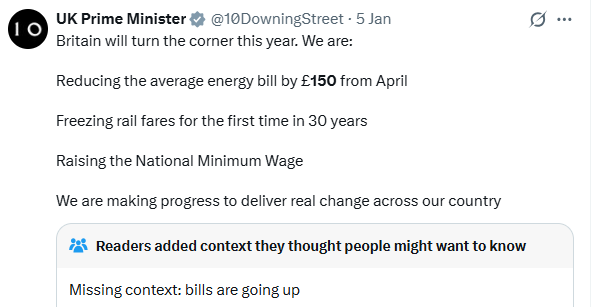
Last week Ofgem released the price cap for the period 1 April to 30 June 2026. Energy bills have come down, by £117 for direct debit customers, quite a long way from the £150 promise. Time to look at what is going on under the covers.
Headline Changes to Energy Bills
The overall energy bill has indeed reduced £117 since the last price cap, coming down to £1,641 from £1,758. Gas bills are down £44 and electricity bills are down £73, all figures including VAT.
However, when Labour came to power in July 2024, the price cap for July-September 2024 was £1,568 so overall energy bills since Labour came to power are up £73, moving in the opposite direction to their original £300 reduction promise.
Wholesale Gas and Electricity Prices
Starting with some good news, Ofgem’s estimate of the wholesale cost of both gas and electricity has reduced significantly since the last price cap. Wholesale gas prices have fallen 12.4% to £24.82/MWh and wholesale electricity prices have fallen 5.8% to £76.60/MWh. The reduction in wholesale prices has led to a reduction of about £19 in direct fuel costs for electricity (excluding costs of CfDs) and ~£44 for gas, both figures quoted ex-VAT.
With gas prices at that level, we might expect wholesale electricity prices to be £50-55/MWh, with the difference being accounted for by carbon costs. The price of carbon has fluctuated wildly during Ofgem’s assessment period rising from ~£55/t in mid-November 2025 to over £70/t in mid-January 2026 before falling to ~£45/t in mid-February after Chancellor Merz of Germany said the EU Emissions Trading Scheme “should be revised or postponed if it undermines industrial competitiveness”. We might therefore hope that actual wholesale electricity prices might be slightly lower than Ofgem’s estimate.
Shuffling Costs from Bills to Tax
Much of the promised £150 reduction in bills was to come from abolishing the Energy Company Obligation (ECO) and moving some of the Renewables Obligation (RO) subsidies from energy bills into general taxation.
Of course the change to the RO scheme is not a real reduction in costs, just shuffling costs from energy bills to payslips. Nevertheless, the cost of RO bills has fallen ~£67 (ex-VAT) on the average electricity bill.
The ECO scheme forced energy suppliers to instal energy saving measures like insulation into homes. However, the Public Accounts Committee found the scheme to be an “abject failure” with 98% of external and 29% of internal wall insulation installations were defective. The ECO scheme has been removed from energy bills cutting about £24 from electricity bills and about £36 from gas bills. However, the Government has similar schemes in place such as the Warm Homes Plan, the Warm Homes Local Grant, the Warm Homes Social Housing Fund, the Great British Insulation Scheme and the Boiler Upgrade Scheme that are funded from general taxation. Again removing the ECO appears another sleight of hand with bill savings offset by other schemes funded by general taxation.
We now have a total of £184 (ex-VAT) or ~£193 including VAT of bill reductions, but the headline reduction is just £117 (VAT). Something else must have gone up.
Changes in Subsidies
In addition to the RO scheme, there are two other subsidy schemes: Contracts for Difference (CfDs) and Feed-in-Tariffs (FiTs).
CfD costs are hidden in the direct fuel cost element of electricity bills. Looking at the detail of Ofgem’s workbook we can see that CfD costs are up ~£6 per customer (ex-VAT) since last time. This reflects Ofgem’s predicted increase in the CfD scheme where they expect the cost to rise from their latest estimate of £2.8bn for 2025/26 to £3.3bn in 2026/27. It is worth noting that in February 2025, they expected CfDs to cost £2.3bn for 2025/26. Moreover, back in November, they expected the cost of CfDs to be £798m in the October-December 2025 quarter and the actual cost has come in at £900m. As wholesale prices fall, CfD subsidies rise so we do not see the full reduction in wholesale prices in our bills.
The cost of FiTs is included in Policy Costs and has gone up about £1.50 (ex-VAT) since last time.
Network Costs
Another big change to energy bills comes in the form of increases in Network Costs. Electricity network costs are up £26 since last time and gas network costs are up £40 (both ex-VAT).
Electricity network costs comprise three components: Transmission, Distribution and Balancing costs. The biggest cost element is the high voltage transmission network and this has gone up a staggering 65% to £81 (ex-VAT) per customer since the last price cap and has more than doubled since Labour came to power. Much of this increase can be attributed to the very high costs of building out the grid to connect remote offshore windfarms. The second part of electricity network costs is the lower voltage distribution network where the cost has fallen about £3.50 per customer since last time. Finally we have balancing costs, where the headline costs have fallen nearly £6 since last time. However, balancing costs vary seasonally, with higher costs from October to March than from April to September. If we compare balancing costs for April-June 2026 to the same period last year we can see underlying balancing costs are up about £5 (ex-VAT) per customer. This reflects the higher penetration of intermittent renewables on the grid and the greater costs of maintaining grid stability.
Other Costs
We should not overlook the impact on bills of several other components: the Capacity Market (CM), the Warm Homes Discount (WHD) and other costs like Nuclear Regulated Asset Base (nRAB).
The CM pays generators to be ready to provide backup to the grid, typically when wind and solar output are very low. The costs of the CM are typically buried in the wholesale cost element of the price cap. CM costs have surged over 77% in the latest price cap to nearly £43 per customer (ex-VAT). This reflects the increase in forecast CM costs we covered over the summer.
The WHD was expanded last year and most of the cost has been moved from the standing charge to the unit rate. The net result is that the cost of WHD and other policy costs have fallen about £7 in electricity bills. Other policy costs including the WHD and Green Gas Levy have added just over £1 to average gas bills.
There are other minor changes to operating costs, debt recovery and the allowance for supplier profits.
Summary and Conclusions
The changes to the price cap are summarised in Figure 2.
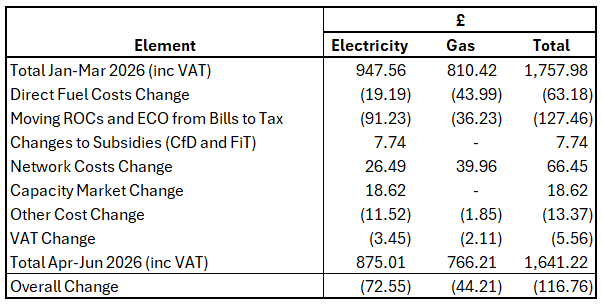
We can see that overall direct fuel costs have fallen £63 which is a real reduction in energy bills. This can be attributed to falling gas and carbon prices, neither of which Labour can claim credit for.
Shuffling costs from energy bills to general taxation has led to a headline reduction in bills of £127. However, this is not a real reduction because we now just pay those same costs through our tax bills instead of energy bills. The government also plans to return the ROC element of these costs back on to energy bills in April 2029.
There is a total increase of nearly £93 across CfD and FiT subsidies, network costs and the Capacity Market. These are real increases in the cost of energy, mostly driven the hidden costs of renewables, over and above the direct subsidies they receive.
The changes to other costs are relatively modest.
We can conclude that Labour’s original pledge to reduce energy bills by £300 was a lie. Moreover, their promise to cut energy bills by £150 in April was a con. The government have done nothing to address the underlying structural reasons for high energy bills. In fact, they have done quite the opposite because without shuffling ROC and ECO costs on to taxation, bills would have gone up even though fuel costs have fallen. They are trying to kid us with an elaborate shell game.
This Substack now has well over 5,100 subscribers and is growing fast. If you enjoyed this article, please share it with your family, friends and colleagues. Please consider signing up for or gifting a paid subscription.
'Responding to the latest energy price cap announcement from OFGEM, Andy Mayer, Energy Analyst at the Institute of Economic Affairs said:
“While any reduction in bills is welcome, OFGEM’s political statements around the changes are both negligent of their duty to protect consumers and a disgrace for an independent regulator.
“The bulk of the £200 (10%) saving from a year ago is not real. It’s a transfer of bad climate policy costs from bills to taxes. Hiding the problem, not solving it.
“This means future taxpayers, your children, are now subsidising old wind farms and failed heat pump promotion campaigns, rather than stopping the waste.
“The rest relates to lower wholesale prices which in turn have benefited from a fall in the regional price of natural gas.
“Which OFGEM do not celebrate, rather they claim absurdly that ongoing exposure to gas (which almost always provides cheaper power than the alternatives before carbon taxes), is the greater risk.
“They further bury in the notes the fact that the fall would have been greater were it not for £66 being added to bills by raising network (or grid) costs, which almost entirely relates to the clean power plan.
“This is propaganda not regulation.'
“While the government is may wish to push whatever net zero nonsense helps them sleep at night, OFGEM exists to serve the public, which requires a drier analysis and transparency on the vast and growing bill for this ideological crusade.”
What bothers me about the whole unreliables scam is that everything is paid for by the bill payer. The company ramming concrete and steel into the sea bed, damaging ecology pays almost no price and receives a generous return. Where is the liability? Where is the risk?
Yet that's the point, isn't it? If the builder faced the risk and an income wasn't guaranteed then they wouldn't be built as they are the absolute definition of uneconomic.
Bills will only ever rise, and rise horrifically. What's comical is that people are falling back to far less efficient fuel methods - wood burners, coal to stay warm and the state is desperate to ban those. The whole scam is just about control and damned the cost.
As Professor Sowell said : "It is hard to imagine a more stupid or more dangerous way of making decisions than by putting those decisions in the hands of people who pay no price for being wrong."