

Green Empire Strikes Back
The green empire is fighting back to protect Net Zero, but the energy jedi will prevail.
Introduction
Recently, it has felt like we had reached a new dawn on energy and climate policy with energy jedi winning the argument against the Net Zero by 2050 target. Reform fought the election on a policy of abandoning Net Zero. More recently, the Tories have followed suit by abandoning the 2050 target, setting out their own cheap power plan and beginning to purge the party of Net Zero zealots like Gavin Barwell.
But the green empire is striking back with a new article (no paywall version here) in the Telegraph from Tim Stanley and Greg Jackson has also weighed in, cheering on Stanley’s article. Even DV himself has weighed in to support Tim Stanley. The trouble with Tim Stanley’s argument, in common with many Net Zero supporters, is that it is based on vibes and emotion, not analysis of actual data.
Time to dive in to see what Tim Stanley and Greg Jackson got so wrong.
Tim Stanley’s Claims
Stanley claimed the wildfires of Europe are “pitiless and persistent” and made “infinitely worse” by the long, hot summer. He also claimed the UK has endured the three worst harvests on record in the past six years and warned that on third of Bangladesh’s agricultural GDP is expected to disappear by 2050. He also stated Pakistan is enjoying a solar boom and said it was ridiculous that Britain was reluctant to follow suit. Stanley also claimed developing countries are more worried about climate change than we are. Finally, he characterised Net Zero sceptics of the online right as “talking itself into corners of angry irrelevance”, as having “misplaced sympathy for the devil” and lacking compassion or charm. However, he became incoherent by claiming he was not arguing for an ideological commitment to decarbonisation and said Kemi Badenoch is correct to abandon the dogma of targets.
Greg Jackson thought Tim Stanley’s article was “superbly written and that renewables solutions are “increasingly economically better than the fossil fuel alternatives”. According to Jackson, solar is the cheapest power on the planet and onshore wind is “bonkers cheap”. He thinks a freer market in electricity could use renewables to drive down energy costs.
Infinitely Worse Wildfires?
Stanley’s article was illustrated by an apocalyptic image of raging wildfires in Europe (see Figure 1). Whilst fires like these must be terrifying for those affected, policy should be set by reference to facts, not emotive images.
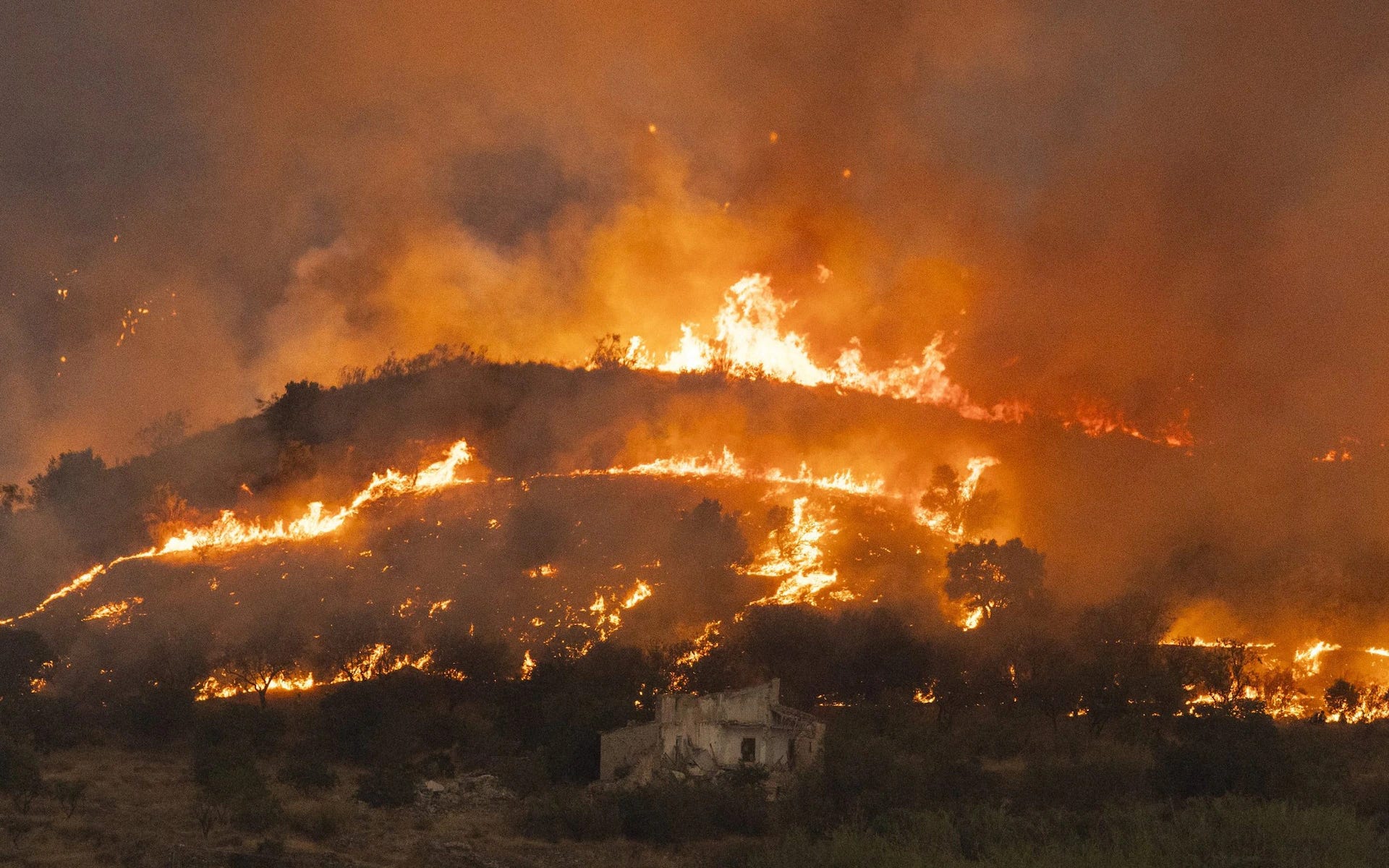
This image was used to support Stanley’s claim that wildfires in Europe are pitiless and persistent and made infinitely worse by long hot summers. We can test this claim against data produced by Our World in Data (OWID) as shown in Figure 2.
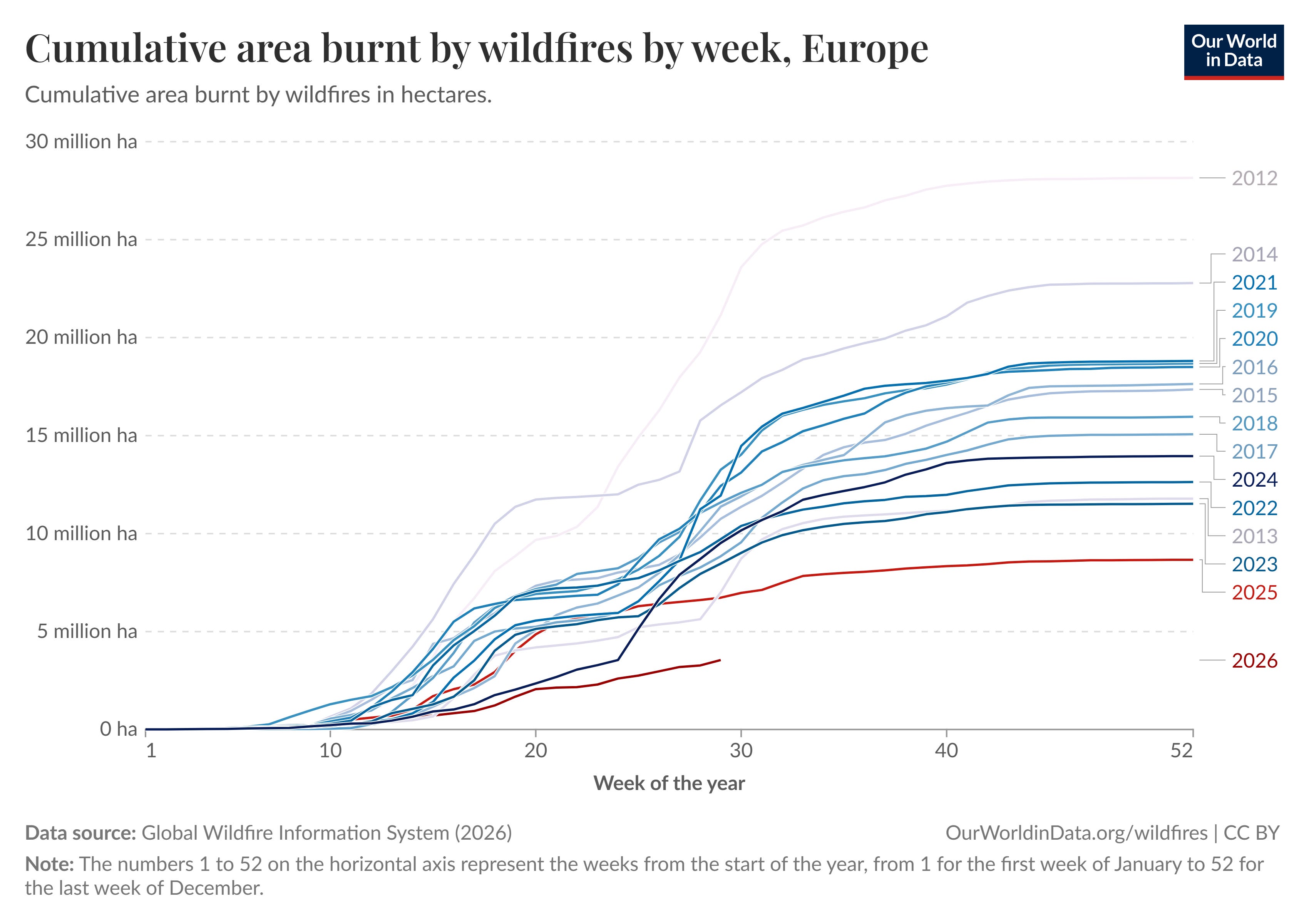
This shows that far from becoming infinitely worse, wildfires in Europe are running at the lowest rate on record. We should note that OWID’s definition of Europe includes the whole of Russia. But even if the geographical scope of the chart is limited to the EU27, 2026 year-to-date is the sixth worst year on record, with area burned running at just 42% of the worst year in 2012. The data undermines the whole premise of Stanley’s article.
Tim Stanley might also note that many of these fires in France are manmade, just not in the way he thinks because 162 people have been arrested in France on suspicion of wildfire arson.
Worst UK Harvests?
Tim Stanley also claimed the UK has endured the three worst harvests on record in the past six years. Although data from OWID only goes to 2024, we can see the claim is false as shown in Figure 3.
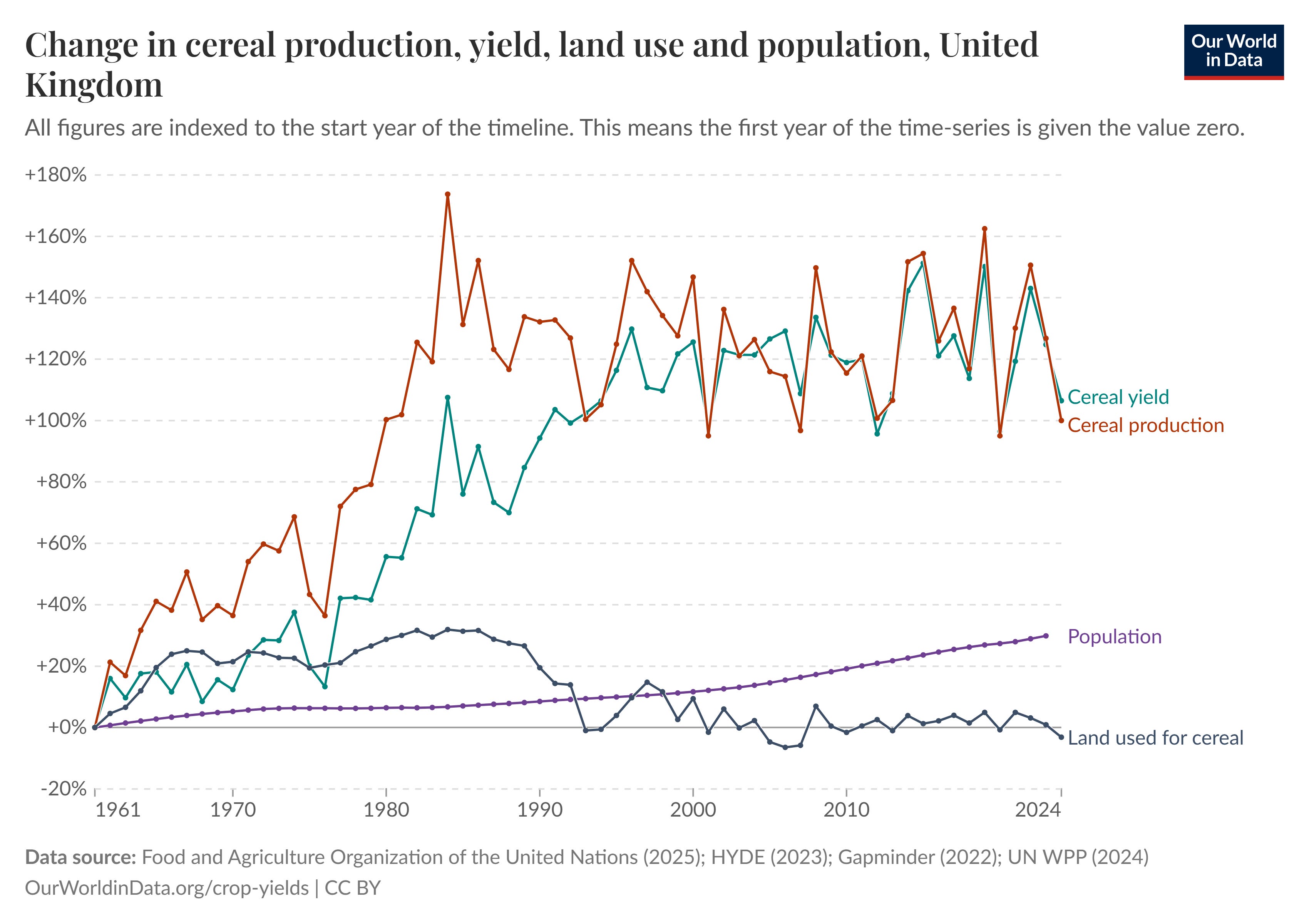
Recent levels of production and yield have not been unusual compared to the last 30 years. Peak production came in 1984, with cereal production around 174% higher than the 1961 baseline, but then there was nearly 32% more land dedicated to cereal production. In 2024, there was twice as much cereal production and 106% better yields than in 1961, despite using 3.1% less land. It certainly looks like those evil fossil-fuel derived fertilisers have helped us to feed ourselves. What is more worrying is the land dedicated to cereal crops looks to have begin a downtrend. Maybe carpeting prime farmland with solar panels is not such a good idea after all.
Bangladesh Agriculture Under Threat?
Stanley’s claim that one third of agricultural GDP in Bangladesh is at risk appears to come from a 2022 report by the World Bank. Again, OWID has data to show that fear is at best misplaced, see Figure 4.
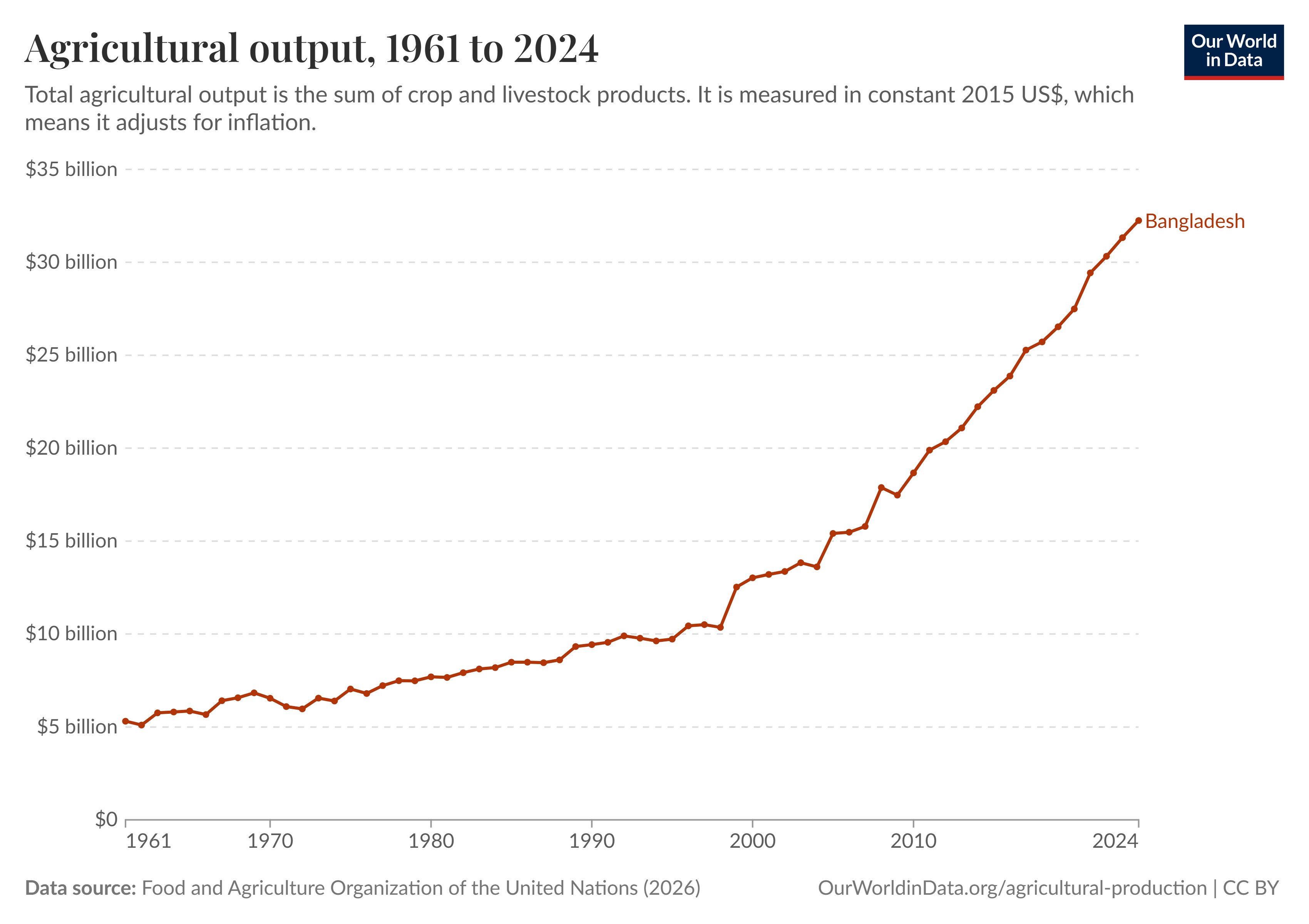
Agricultural GDP in Bangladesh is soaring and the 13.3m climate migrants expected by the World Bank are probably not going to materialise, because deaths from natural disasters in that country have plummeted from a one-off peak of 1.9m in 1943, due to drought to just 28 in 2025, with 10 of those from earthquakes which are of course unrelated to climate.
Bangladesh also seems more concerned with economic development than climate change because energy consumption is soaring and almost all of it comes from hydrocarbons – coal, oil and gas, see Figure 5.
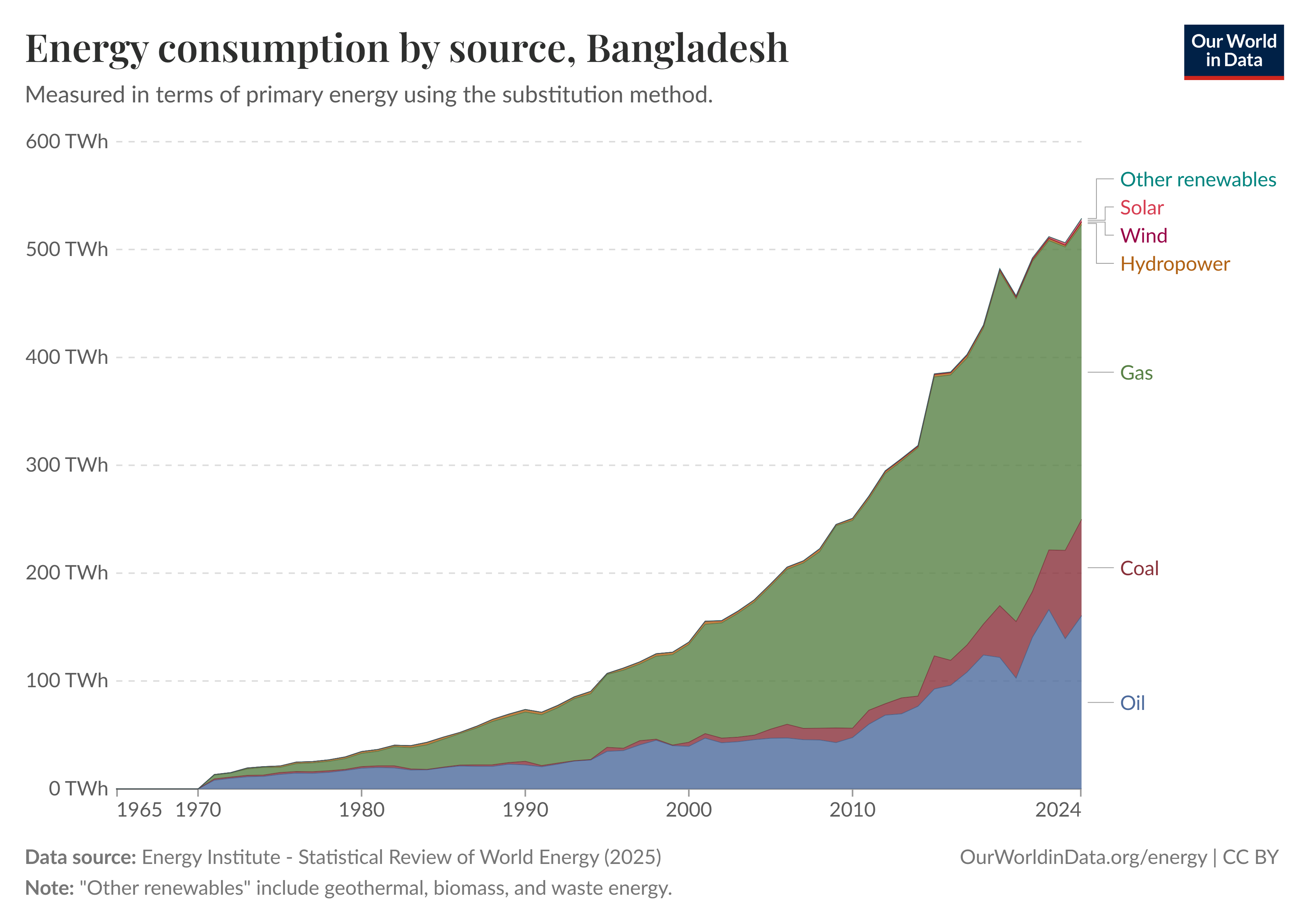
This contradicts Stanley’s claim that developing countries are more concerned about climate change than we are.
Pakistan Solar Boom?
Tim Stanley’s article also claimed:
“Contemporary Pakistan is enjoying a solar boom. How? Because millions of peasants, sick of high utility prices inflated by corruption, have bought cheap solar panels from the Chinese and hung them from their roofs and balconies.”
He went on to chide Britain for not following suit. It is true that Pakistan now generates nearly 19% of its electricity from solar and the solar share has been growing rapidly. Britain’s solar share is 6.6% of electricity generation. Despite this disparity in solar penetration, the carbon intensity of Pakistan’s energy is higher than the UK’s, see Figure 6.
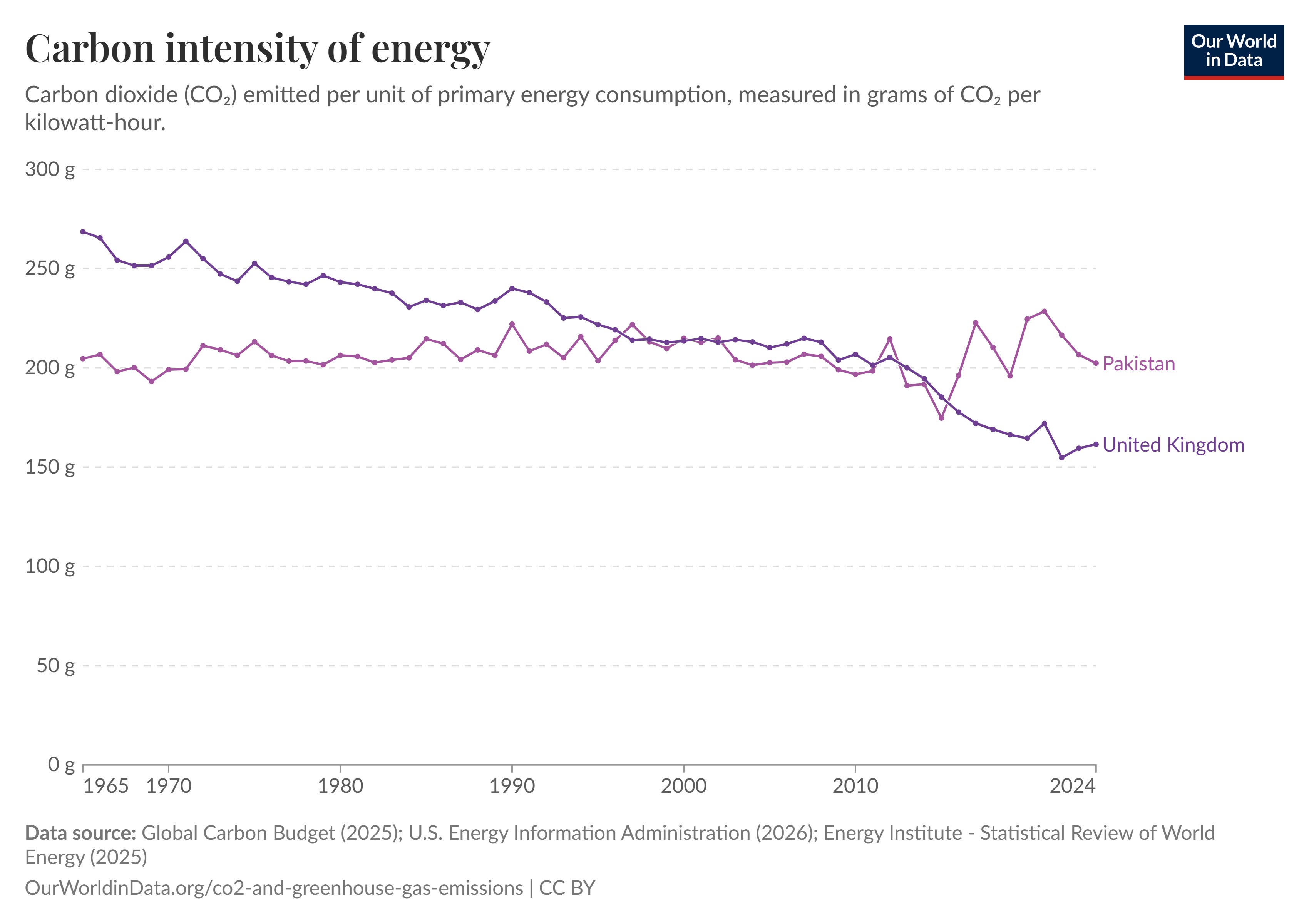
By international standards, Pakistan generates very little electricity, producing just 764kWh per person, compared to the world average of 3,860kWh, the UK’s 4,203kWh and China’s 7,474kWh per person. A big part of the reason remote regions of Pakistan are turning to solar power is because less than 55% of households are connected to the grid. For them, access to some solar is better than no power at all. Another reason Pakistan is more suited to solar power is latitude. Pakistan lies between 23 degrees and 37 degrees north, where it is sunnier than Britain which is much further north. This is why the World Bank rated Pakistan in roughly the top quartile of countries for practical solar power potential and the UK second bottom, just above Ireland.
Poor Countries Worried?
As shown above, Bangladesh does not appear to be overly concerned about climate change, in contradiction to Tim Stanley’s claim that poor countries are more worried than we are. OWID also produces data to show carbon dioxide emissions by income group, see Figure 7.
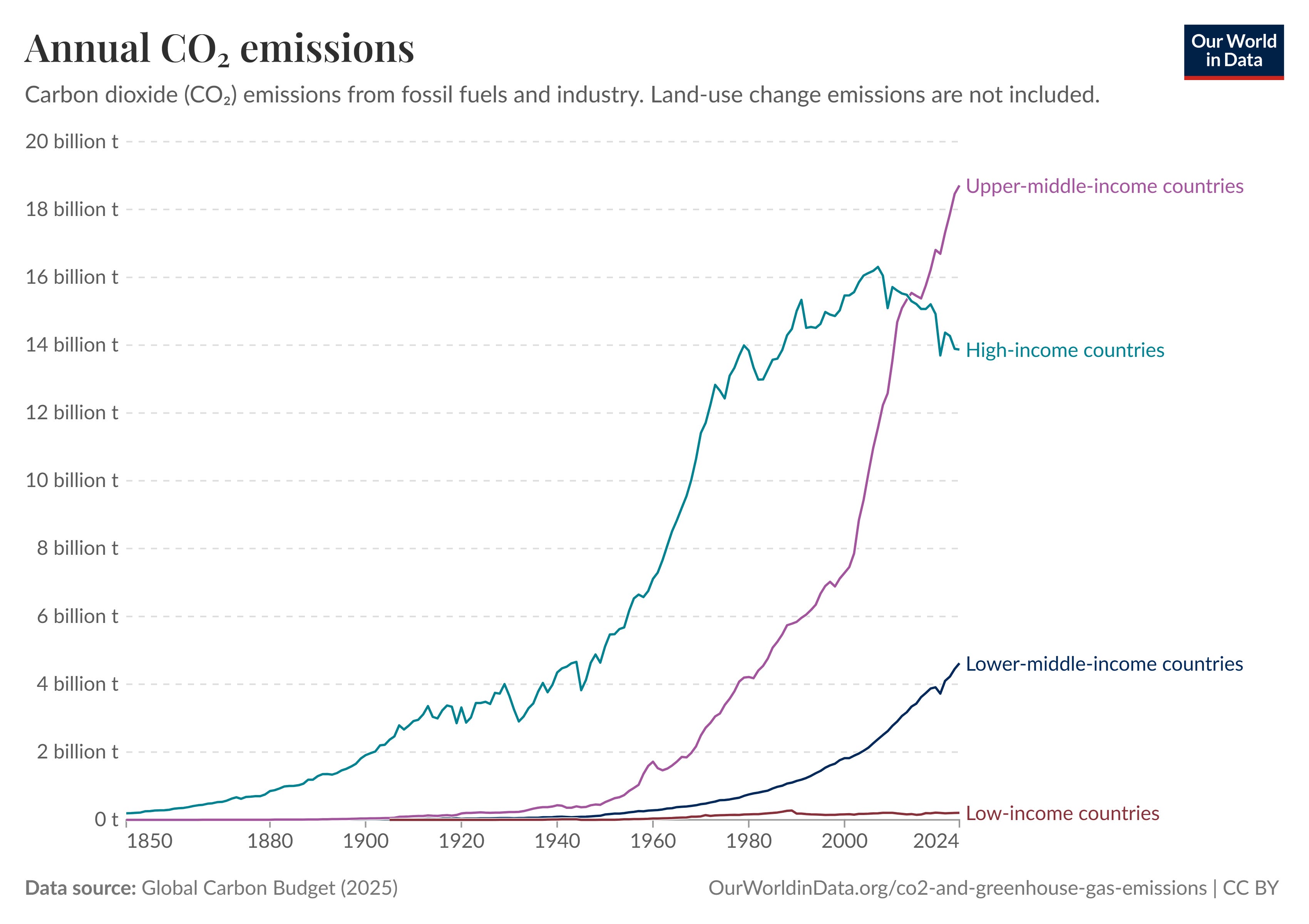
Even though emissions from high-income countries like Britain are falling, emissions from upper-middle and lower-middle income countries are rising sharply. Emissions from low-income countries are low and rising slowly. High-income countries will become poorer and be overtaken by upper-middle income countries who want to become more prosperous.
There is growing demand for oil and gas in Africa. For example, a farmer in Kenya, Jusper Machogu, campaigns for fossil-fuels for Africa because he wants to Just Stop Toil. He is getting angry that Greenpeace is acting like a neo-colonialist, blocking a new oil refinery in his country. Another strike against Tim Stanley’s evidence free tirade.
Renewables Increasingly Economically Better?
Let us turn now to Greg Jackson’s claims that renewables are “increasingly economically better” and a freer market for renewables would being down energy costs. As we have discussed before and as shown in Figure 8 the UK already has the highest industrial electricity prices in the developed world and domestic prices are also among the highest.
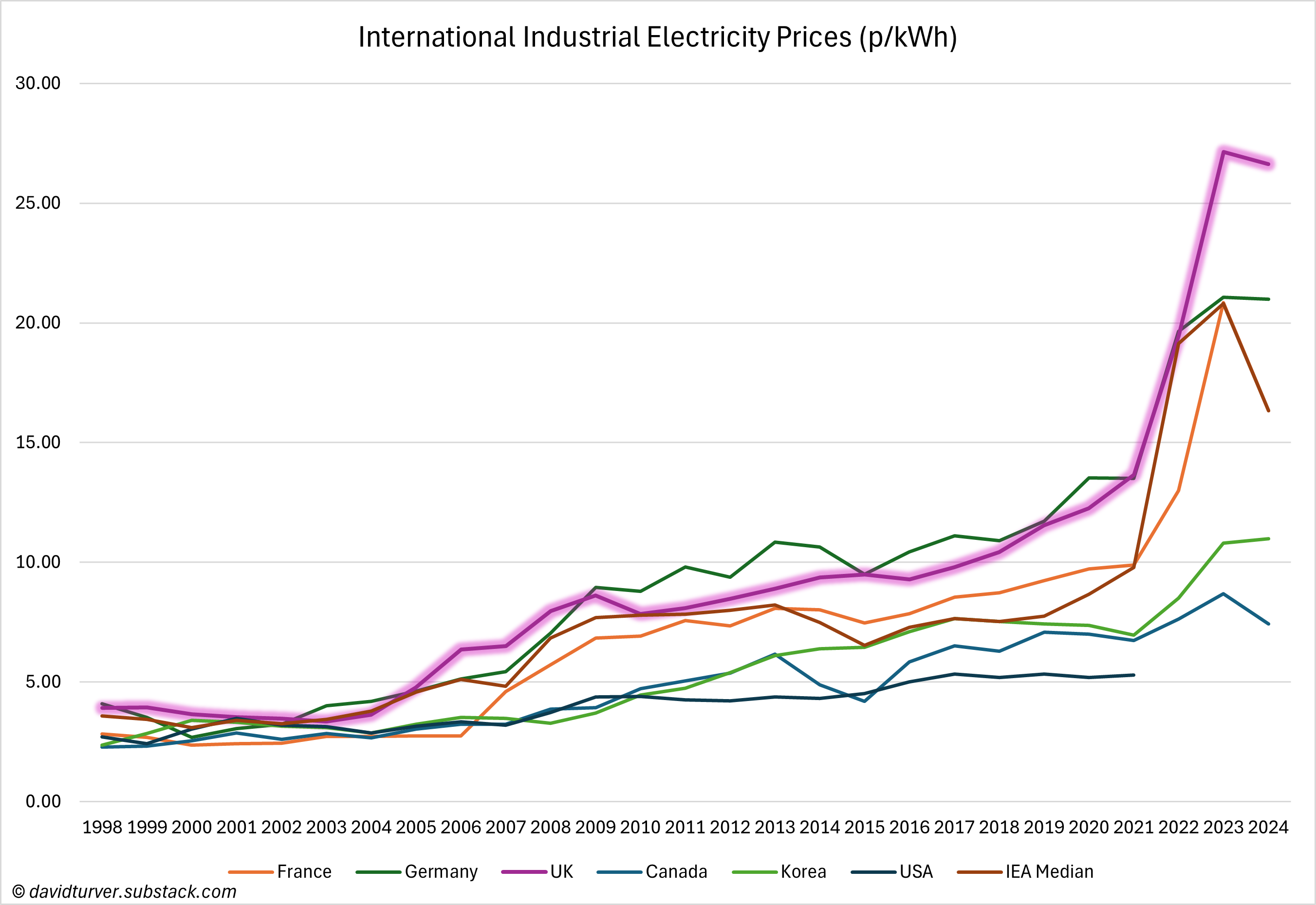
The term of contracts for difference (CfDs) has been extended to 20 years and the prices awarded in AR7 for offshore wind and onshore wind rose in AR7. Prices for solar dipped slightly, but on a like-for-like 15-year contract basis prices rose. There is no evidence that the base cost of renewables is falling.
The news gets worse though, because the cost of integrating intermittent renewables into the grid is soaring, with balancing, backup and grid expansion costs set to triple from 2024/25 levels by 2030/31 as shown in Figure 9.
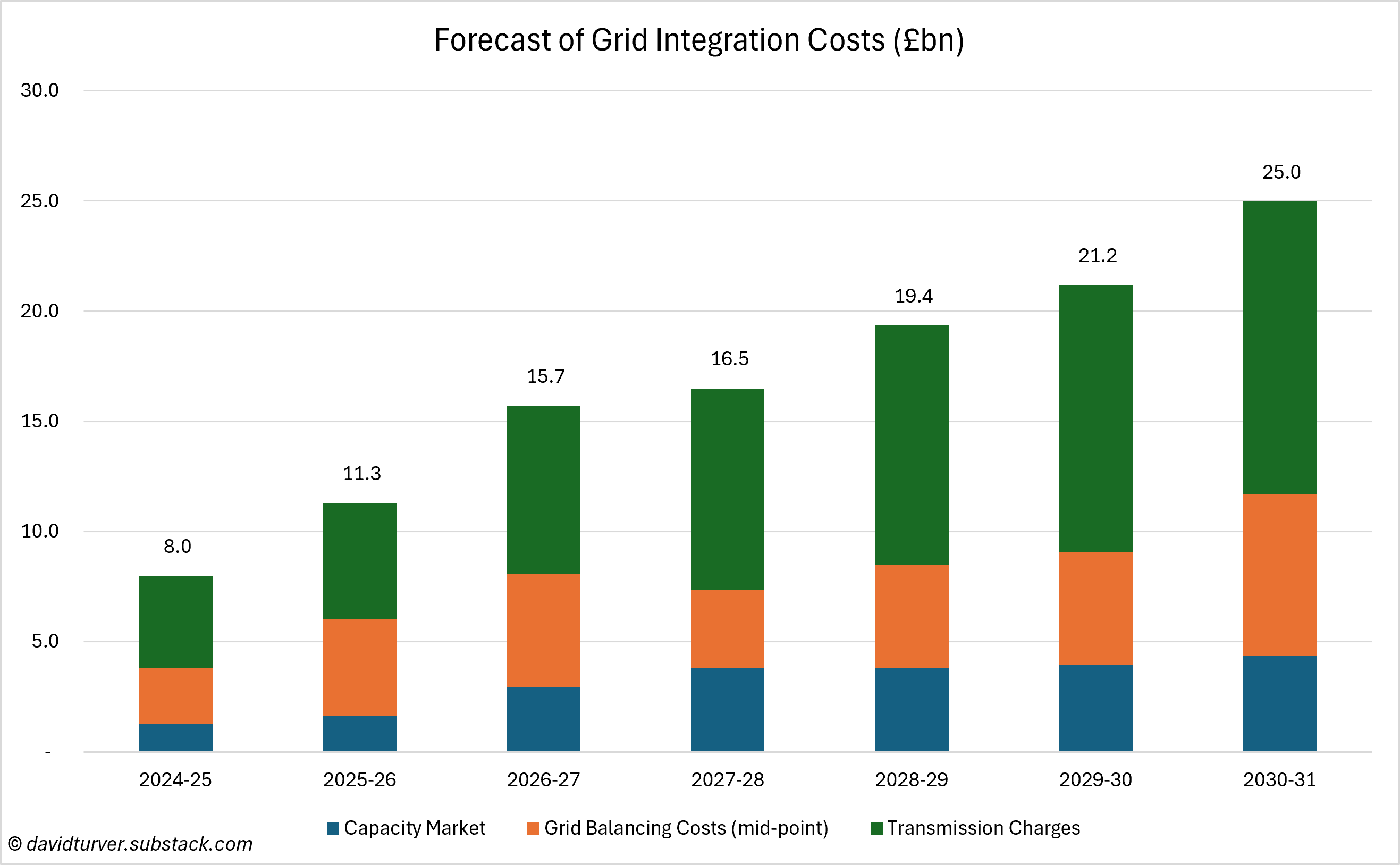
Far from becoming “increasingly economically better” intermittent renewables are getting increasingly expensive. If were to make the electricity market freer by for instance cutting carbon taxes on gas-fired electricity, eliminating renewables subsidies and making them pay for their grid integration costs then most renewables projects would fail and there would be little new spending. Greg Jackson is wrong on both his main points.
Who Lacks Compassion?
Tim Stanley’s most emotive line was when he accused Net Zero sceptics of having misplaced sympathy for the devil and lacking compassion. We may ask what is compassionate about making electricity so expensive that families have to choose between heating and eating? Where is the compassion for oil and gas workers in Aberdeen losing 1,000 jobs per month? Is there an ounce of sympathy for Port Talbot steelworkers, Grangemouth refinery workers or thousands more losing their jobs in other energy intensive industries like petrochemicals, chemicals, ceramics and glass? Isn’t it simply evil to deprive the developing world of cheap, abundant hydrocarbons to support their economic and social development?
Conclusions
We know the energy jedi are winning the argument when the green empire has to resort to emotive pictures and mendacious invective to make their point. None of Tim Stanley’s points stand up to close scrutiny and the cheerleading Greg Jackson is reduced to making completely false claims to stop his Octopus Energy business from collapsing into further losses.
The trouble is that lies travel halfway round the world before the truth has got its boots on, so the green empire striking back can be temporarily effective. But be in no doubt, the energy jedi will return and economic and physical reality will prevail.
Eigen Values now has over 5,600 subscribers and is growing fast. If you enjoyed this article, please share it with your family, friends and colleagues. Please consider signing up for or gifting a paid subscription.
SW Europe and the UK has suffered an unusual period of hot, dry weather due to a stationery, blocking high pressure area. This is a weather event, not climate change due to man made emissions. To argue otherwise requires a scientific explanation of how a marginal increase in CO2 levels can cause a localised high pressure system over one small part of the planet. I await such an explanation with interest, but not much hope.
It's not like droughts have never happened before in England and Europe. Interestingly, the past few years resemble 13th and 17th century weather patterns. Here is a very good study on historical droughts: https://cp.copernicus.org/articles/16/1027/2020/cp-16-1027-2020.pdf
Presentism is a scourge for rational thought.